

Sizing
Size guide
Every piece lists its size, but here is what the numbers mean and how to choose. When in doubt, your piercer can confirm your sizes in seconds.
The three numbers
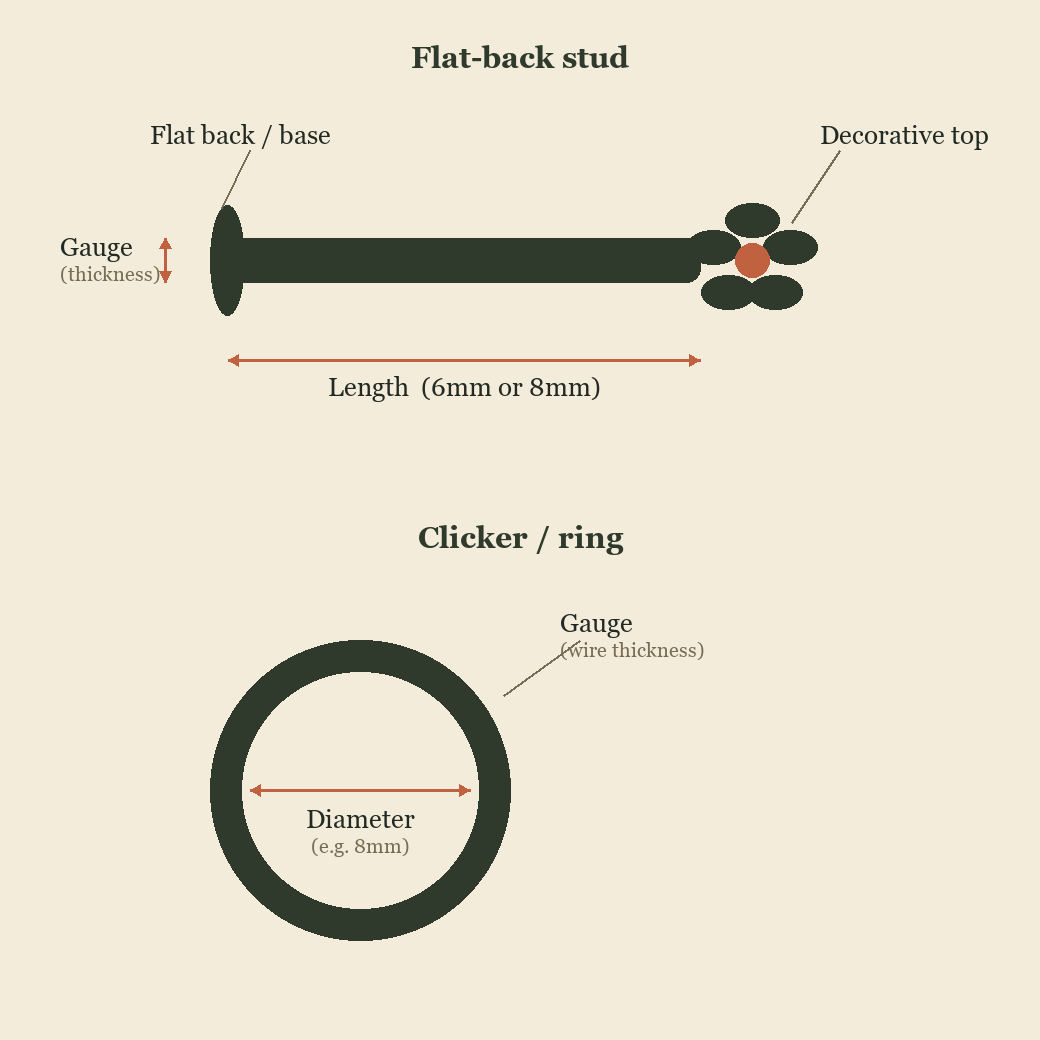
- Gauge is the thickness of the post. A bigger number is thinner: 16g = 1.2mm, 18g = 1.0mm.
- Length (for flat-back studs) is the bar between the back disc and the top. Common lengths are 6mm and 8mm.
- Base is the flat back disc diameter, usually 3mm to 4mm.
- Diameter (for clickers and hoops) is the ring size, most often 8mm.
| Gauge | In mm | Usually for |
|---|---|---|
| 16g | 1.2mm | Most cartilage and lobe piercings |
| 18g | 1.0mm | Delicate lobes and some nostril piercings |
The ear, top to bottom
A real, fully curated ear. Here is where each piercing sits.
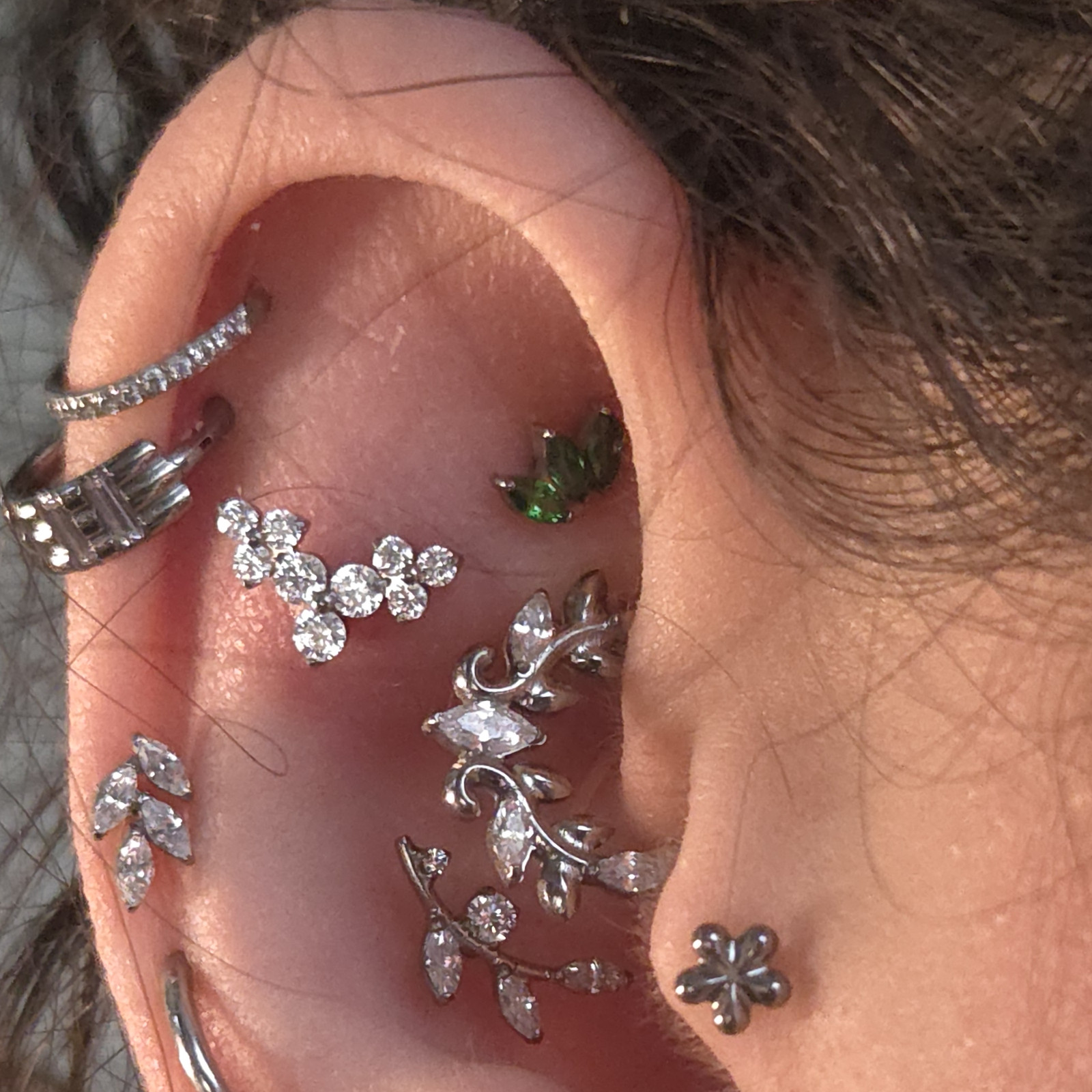
- Helix — along the upper outer rim of the ear.
- Forward helix — the upper rim at the front, near your face.
- Flat — the flat area of cartilage just inside the helix.
- Rook — the inner ridge above the ear canal.
- Daith — the innermost fold, above the canal.
- Conch — the large bowl in the centre of the ear.
- Tragus — the small flap in front of the ear canal.
- Lobe — the soft lower part, including second and third lobe placements.
How to choose your size
Match your jewellery to your existing piercing. Most ear piercings are 16g, and 6mm or 8mm covers most placements: 6mm sits snug and close (great for a healed lobe or helix), while 8mm gives a little room (better for thicker spots like the conch, or if there is any swelling). If you are between sizes, size up.
How to measure what you have
If you have a piece that fits well, you can measure it: the post thickness is your gauge, and the bar length (disc to top) is your length. A small ruler or a piercer will get you there. For rings, measure straight across the inside.
Still not sure?
Ask your piercer, or get in touch and we will help you choose. You can also read our guide to gauges.