

If you are trying to cut down on what irritates your skin, jewellery is an easy place to start. Nickel is one of the most common causes of contact allergy, and the metal in your ears sits against your skin around the clock. This guide compares the three metals you will see most often, and which ones are genuinely safe for sensitive skin.
8 min read
The short answer
- Fresh or cartilage piercing: implant-grade titanium (ASTM F-136). Nickel-free, doesn’t tarnish, and the lightest option.
- Healed lobes only: sterling silver, solid 14k/18k nickel-free gold, or graded implant steel (ASTM F-138).
- Never: “surgical steel” with no grade listed, gold plated, vermeil, or unmarked costume metal.
When you’re buying jewellery for a piercing, especially a fresh one, the metal matters far more than the design. You may not think it’s that important, but the wrong metal can trigger reactions, slow healing, or leave you with an angry, bumpy piercing. Read on to find out the differences between titanium vs surgical steel vs silver and gold for piercings.
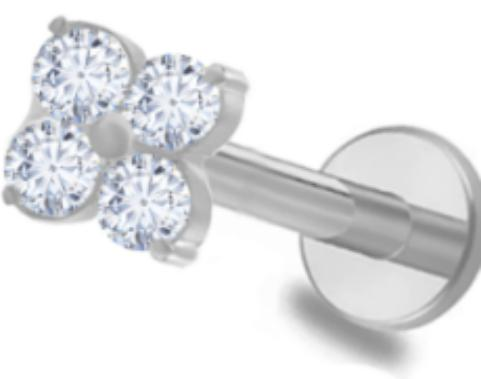
One of the biggest issues with a lot of the metals is the nickel content. Nickel is usually found in sterling silver, stainless steel, surgical steel and a lot of the cheaper ‘costume jewellery’ you find in stores, and it is one of the biggest irritators for piercings. This is especially true for healing piercings and for those with more sensitive skin or nickel allergies.
When in a piercing, nickel reacts to sweat and moisture, which then lets out the nickel ions. Your body then produces an immune response, which often shows up as contact dermatitis. It is one of the most common contact allergies and once sensitised, it’s there for life. For more information on nickel contact dermatitis and argyria, visit DermNet.
Here’s an honest comparison of the three metals you’ll see the most when searching for new jewellery.
Costume jewellery
Before I get to the big three, a quick word on the cheap stuff. Costume jewellery is mystery metal. An unmarked alloy of whatever was cheapest that week, usually with a thin plating over the top and very often loaded with nickel.
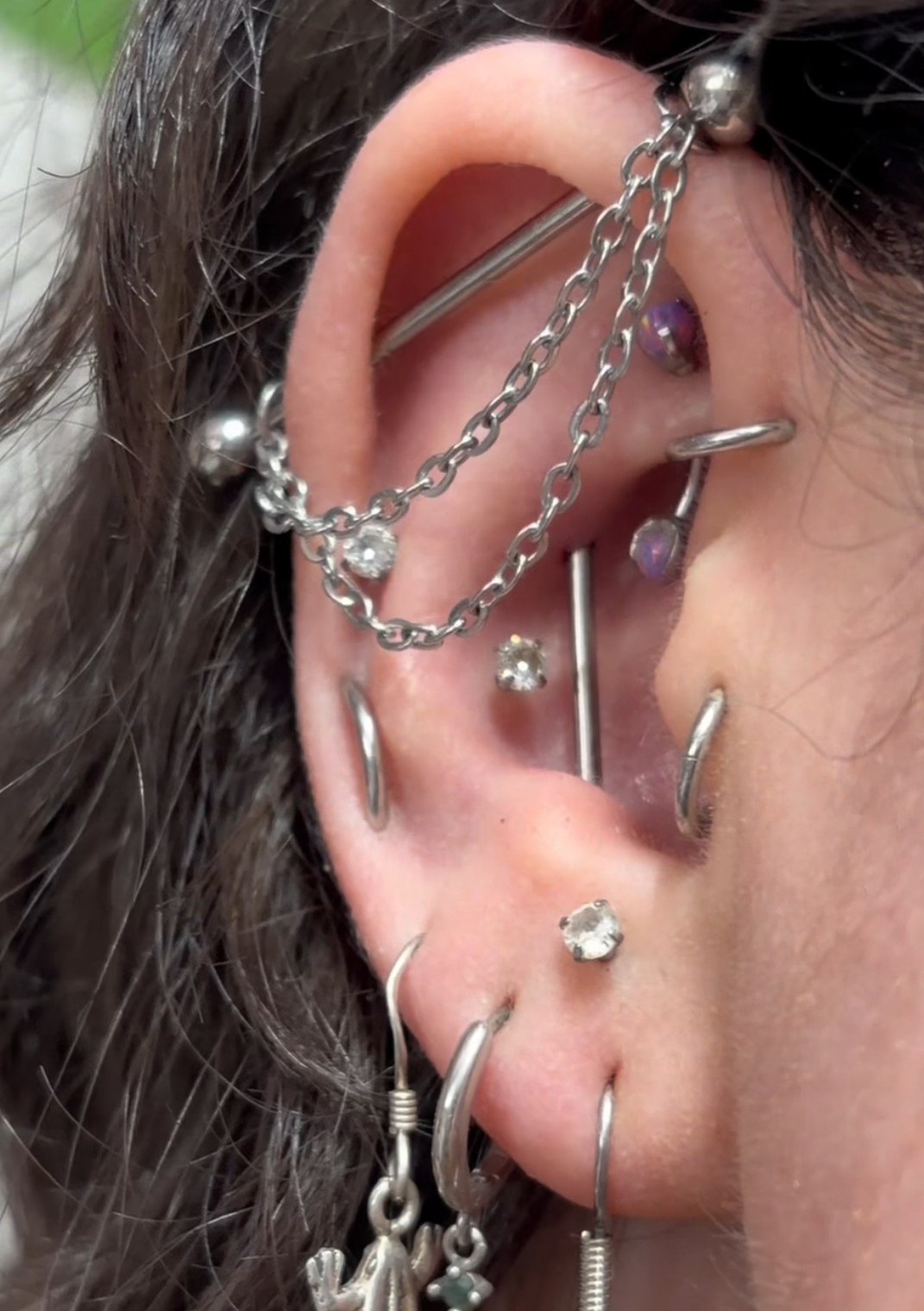
It’s fine on a necklace or a bracelet, where it only ever sits against unbroken skin. Inside a piercing channel, it’s a gamble you will usually lose. If a piece of jewellery cost $4 and doesn’t say what it’s made of, it isn’t made of anything you want in your ear.
Sterling silver: beautiful, but not for cartilage or healing piercings
Sterling silver (92.5% silver) is usually alloyed with copper or nickel. This is because pure silver is too soft for jewellery, so the added materials make it far more durable and practical. However, these materials are not safe for piercings, particularly fresh ones.
Sterling silver tarnishes and can irritate the wound when in a piercing. Silver tarnishes faster when in a piercing due to the exposure to sweat, water, skincare and perfume. Tarnished earrings in a healing wound are just asking for an infection.
In the warm and moist environment of a healing piercing, sterling silver can even leave a grey mark on the skin (argyria). It is caused by an excessive buildup of silver in the body’s tissues. This is rare but it’s permanent, so why risk it?
It’s lovely for earrings in fully healed lobes, but it should never go into a fresh or cartilage piercing. It is also perfect for occasional wear, but you should be proactive about keeping it clean and dry.
What is the difference between lobes and cartilage, you may ask? Sterling silver earrings are generally always 20g. This means that they are far thinner than what cartilage piercings are pierced with (usually 16g, depending on the piercing). Using the incorrect gauge and material in a cartilage piercing can cause a world of issues, pressure and irritation.
Surgical steel: better, but ‘surgical’ isn’t a guarantee
“Surgical stainless steel” actually sounds quite safe, and many people think that it’s the best option. “It’s got surgical in the name; it must be good!” However, the term is used quite loosely and is not regulated at all. Most surgical steel actually contains nickel (the single most common cause of metal allergies) and cheaper grades can leach it into your skin.
Genuine implant-grade steel (ASTM F-138) binds nickel tightly into the alloy, but if a seller can’t tell you the grade, treat ‘surgical steel’ with caution. It really can have any amount of nickel or copper in it.
What does implant-grade even mean? Many people think that this term is just new marketing fluff, but it’s more than that. The ASTM certification system comes from ASTM International, an independent body that publishes the exact material standards a metal must meet before it’s allowed inside a human body. Think bone plates and hip replacements.
F-138 is the implant standard for steel; F-136 is the one for titanium. To carry this, a batch of metal has to hit strict limits on composition, purity and finish, and it comes with paperwork (a mill certificate). This traces it back to the exact batch it was made in. So ‘implant-grade’ isn’t a vibe. It’s a testable claim with a paper trail behind it.
Now the words that people do throw around as marketing fluff are 316L / 316LVM. This just essentially means a family of stainless steel, not a safety certification. The L stands for low carbon, and the VM means vacuum melted. It is a cleaner production method with fewer impurities, but here’s the catch. 316L still contains roughly 10 to 14% nickel, and the stamp on its own doesn’t tell you the metal was made or finished to implant standard.
Plenty of fashion jewellery is stamped 316L and made to fashion-jewellery tolerances. True implant-grade F-138 is a 316LVM steel that has been produced, tested and polished to the implant specs. That’s what keeps the nickel locked in. So 316L can be perfectly fine in healed piercings for people without sensitivities, but it’s more of a marketing reassurance then anything else.
Implant-grade titanium: the safe standard
ASTM F-136 titanium (Ti-6Al-4V ELI) is the same material used in surgical implants. It’s inert, nickel-free, lightweight, and doesn’t tarnish. This is exactly why reputable piercers use it for fresh piercings. In my opinion, I wouldn’t be pierced by a piercer who doesn’t offer ASTM F-136 titanium piercings.
However, there are other grades of titanium, like commercially pure titanium (F-67). This is also body safe, but it is softer, because it’s unalloyed. That means it scratches more easily and doesn’t hold a mirror polish as well.
You probably think surface finish may not matter in a piercing. But it genuinely does. Tiny scratches give bacteria and gunk somewhere to sit. It’s also not as strong, which becomes a problem on thin 16g and 18g posts. Body safe? Absolutely. But for jewellery that lives in a piercing, F-136 is simply the better tool for the job.
Titanium is also incredibly light, which genuinely makes a difference for larger cartilage pieces and long wear.
Piercers pair titanium with internally threaded or threadless ends for initial piercings. This avoids dragging the thread of the jewellery through the wound. Ideally, internally threaded or threadless piercing jewellery should always be used to avoid irritation of the piercing channel.
For anything going through your skin, implant-grade titanium is the safest place to start.
What about gold?
Solid 14k or 18k nickel-free gold is body-safe and beautiful, however it can be pricey. Gold-plated jewellery is not a safe substitute: the thin plating wears through to whatever base metal is underneath, which is often nickel.
Gold PVD: the gold look without the plating problem
There is a middle path for gold tones: gold PVD over implant-grade titanium. PVD (physical vapour deposition) isn’t plating. Instead of electroplating a soft layer of gold that starts flaking within months, the colour is bonded to the titanium in a vacuum chamber, creating a finish several times harder and far more wear-resistant than traditional plating.
Here’s the part that matters for your skin: the metal underneath is still nickel-free, implant-grade titanium. Gold plating is risky precisely because of what’s hiding under it.
Once it wears through, your skin is sitting on cheap brass or a nickel alloy. With PVD over implant-grade titanium, even years of knocks and cleaning only ever bring you back to: Implant-grade titanium. There is no nasty surprise under the gold.
Two honest caveats. PVD is still a surface finish, so treat it kindly. No abrasive cleaning and take it out for chlorine-heavy pools if you want it looking fresh for longer. And for a brand-new piercing, most piercers will fit plain titanium first anyway; you can switch to gold PVD once things have settled.
The takeaway: For a fresh or cartilage piercing, choose implant-grade titanium. Keep sterling silver for healed lobes and always ask a seller for the material grade before you buy or are pierced.
How to ask a seller about their materials: a mini guide
Ask simply, “What is your jewellery made from, and can you prove it?” If they have nothing to hide, their answer may sound like “ASTM F-136 titanium, mill certificate available on request”, compared to a red flag like “it’s titanium, it’s fine” or “all titanium is the same quality”.
A few more questions worth keeping in your back pocket:
- “What’s the base metal under the coating?”: for anything gold-toned or coloured. The answer you want is implant-grade titanium. The answers you don’t want are “brass”, or silence.
- “Is it internally threaded or threadless?”: externally threaded jewellery drags a screw thread through your piercing channel every single time you change it.
- “What gauge is it?”: a seller who can’t tell you the gauge hasn’t thought much about the ear it’s going into.
- “Can you get a mill certificate?”: a small seller won’t print one with every order, but a good one knows exactly what it is and can get it from their manufacturer.
You are not being difficult by asking. A seller who gets cagey about a materials question has answered it anyway.
If you want to see the industry baseline for yourself, the Association of Professional Piercers publishes its minimum standards for initial piercing jewellery which is worth a five-minute skim before you spend money.
The quick comparison: Titanium vs Surgical Steel
If you only remember one thing from this guide, make it this table.
| Metal | Nickel risk | Tarnishes? | Safe for a fresh piercing? | Rough price |
| Implant-grade titanium (ASTM F-136) | None | No | Yes, the gold standard | $$ |
| Commercially pure titanium (ASTM F-67) | None | No | Yes, but it scratches more easily | $$ |
| Implant-grade steel (ASTM F-138) | Very low (locked into the alloy) | No | Acceptable, though titanium is kinder to sensitive skin | $$ |
| “Surgical steel” with no grade given | Unknown (often moderate to high) | Rarely | No | $ |
| Sterling silver (925) | Low to moderate, depending on the alloy | Yes, fast in a piercing | No, healed lobes only | $ to $$ |
| Solid 14k/18k nickel-free gold | None, if genuinely nickel-free | No | Yes, 14k or higher, unplated | $$$$ |
| Gold PVD over implant-grade titanium | None | No | Yes, verify the base metal; ideal once healed | $$$ to $$$ |
| Gold-plated / vermeil / “dipped” | Depends what’s underneath (often high) | The plating wears off | No | $ |
| Costume / mystery metal | Assume high | Frequently | Absolutely not | $ |
How to read a jewellery listing: a 30-second checklist
Words that actually mean something:
- ASTM F-136, F-67 or F-138: a real, checkable standard
- Implant-grade: but only when it sits next to one of the codes above
- Ti-6Al-4V ELI: the full name of F-136 titanium
- Internally threaded or threadless
- Nickel-free: alongside a grade, not instead of one
- Mill certificate available
- Gauge and length listed: 16g, 18g, 6mm, 8mm and so on
Words that mean nothing on their own:
- Hypoallergenic: completely unregulated; it means whatever the seller wants it to mean
- Surgical steel: with no grade
- “Titanium”: with no grade, it could be almost anything
- Gold plated, gold dipped, vermeil
- “Won’t irritate sensitive ears”
If a listing is all adjectives and no standards, that is your answer.
What about the price gap on a whole ear?
This is where people flinch, and it is worth doing the sums properly. Say you have six piercings and you want to fill all of them. In steel that might be sixty dollars. In titanium it is closer to two hundred. That is a real difference and it is not nothing.
But titanium pieces do not need replacing. They do not tarnish, the finish does not lift, and the flat back means you are far less likely to lose one. Cheap studs get replaced, lost and thrown out, and most people who buy them buy them repeatedly. Over a few years the totals converge, and the titanium ear did not spend any of those years being itchy.
There is also a middle path I would genuinely recommend if the budget is tight. Buy titanium for the piercings that matter, meaning anything healing, anything in cartilage and anything you sleep in. Wear whatever you like in a healed lobe for special occasions. You do not have to solve the whole ear at once.
FAQ
Is titanium worth the extra cost?
Yes, and it’s not close. The difference between a mystery-metal stud and an implant-grade titanium one is often less than the price of a coffee, and the titanium piece can be worn essentially forever. One irritated piercing, the saline, the piercer visits, the months of restarting the healing clock, costs far more than the upgrade ever did. The cheapest jewellery is the piece you never have to replace.
Can I put sterling silver in once my piercing is healed?
In fully healed lobes, yes that’s exactly where silver belongs, but keep it for your lobe piercings. Keep it clean and dry, take it out for swimming and sleeping, and give it a polish when it tarnishes. For cartilage, stick with titanium even after healing: silver earrings are usually the wrong gauge for cartilage, and the tarnish problem never goes away.
What is 316L steel?
A grade of stainless steel: 316 is the composition family, L means low carbon. It’s the most common metal in affordable body jewellery, and it does contain nickel, usually around 10 to 14%. Made properly to the implant standard (ASTM F-138), that nickel stays locked in the alloy. Stamped on a $3 barbell with no other information, it tells you very little. Fine for many people in healed piercings; not what you want in a fresh one.
Is ‘hypoallergenic’ a real standard?
No. There is no regulation, testing requirement or legal definition behind the word and anyone can print it on anything. Ignore it entirely and look for a material grade instead. ‘Hypoallergenic’ is a mood; ‘ASTM F-136’ is a fact.
Is surgical steel good for piercings?
Only when it’s graded. Genuine implant-grade steel (ASTM F-138) is fine for most people in a healed piercing. “Surgical steel” with no grade attached is an unregulated marketing term, usually contains nickel, and is a poor choice for anything fresh. If the seller can’t name the standard, assume the worst.
Is silver or titanium better for piercings?
Titanium, and it isn’t close. Implant-grade titanium is nickel-free, doesn’t tarnish, and is safe in a fresh or cartilage piercing. Sterling silver tarnishes quickly inside a piercing, is usually alloyed with copper or nickel, and belongs in healed lobes only.
Is sterling silver or surgical steel better for piercings?
For a fresh piercing, neither is the right answer, but graded implant steel (ASTM F-138) beats sterling silver. Steel won’t tarnish in a healing wound; silver will, and fast. If the steel has no grade listed, it’s a gamble either way. Titanium beats both.
Surgical steel vs titanium: which should I choose?
Titanium. Both can be made to a genuine implant standard, but titanium (ASTM F-136) is nickel-free by composition, while even implant-grade steel is roughly 10 to 14% nickel locked into the alloy. Titanium is also noticeably lighter, which matters for cartilage and for long wear.
Is titanium better than sterling silver for piercings?
Yes, for anything fresh, any cartilage piercing, and anything worn around the clock. Sterling silver is for healed lobes and occasional wear, kept clean and dry.
Is 316L surgical steel nickel free?
No. 316L stainless steel contains roughly ten to fourteen percent nickel. It is described as low release rather than nickel free, meaning most of the nickel stays locked in the alloy under normal conditions. In a healing piercing those conditions do not apply.
Is G23 titanium the same as implant grade?
Yes. Grade 23, G23, Ti-6Al-4V ELI and ASTM F-136 all describe the same alloy. Grade 5 titanium is a related but less refined version and is not the implant standard, so it is worth checking which one is meant.
Will titanium set off airport scanners?
No. Body jewellery is far too small, and titanium is not especially magnetic. This comes up a lot and it is not something to worry about.
Can I mix titanium and steel in the same ear?
Physically, yes, nothing bad happens between the two. Practically, if one piercing is reacting and the others are not, the metal in the reacting one is the first thing to change.
How do I know what size to order?
Gauge and length both matter and they are easy to get wrong. The size guide shows exactly what is being measured, and my guide to ear piercing placements covers what suits each spot.
Look after it once it’s in
The right metal is only half the story, the other half is how you treat the piercing while it heals, and getting your jewellery downsized once the swelling goes down. I’ve covered all of that in the piercing aftercare guide
So, the short version: buy the tested standard, not the adjective. Implant-grade titanium for anything fresh or fussy, sterling silver saved for the healed lobes you love, and solid gold or gold PVD when you want the warmth without the worry. And never feel awkward asking a seller what’s actually in their jewellery, the good ones love the question.
This is general information, not medical advice. See your piercer or GP with any concerns.
Leave a Reply