

Piercing jewellery is a lovely gift and an easy one to get wrong, because unlike most jewellery it has to fit. A necklace is one size. A labret has a gauge, a length, a back and a mechanism, and the wrong combination sits in a drawer forever. The good news is that there are a handful of choices that are almost impossible to get wrong, and a few simple questions that make the rest easy.
This is a practical gift guide for buying piercing jewellery in Australia, written for people who do not have piercings themselves and are shopping for someone who does.
If you know nothing about their piercings
Buy implant grade titanium, in a flat back labret, 16 gauge, 8mm long. That combination fits more piercings than any other single specification, it is the standard most Australian piercers use, and a slightly long post is far more comfortable than a slightly short one. If you buy one thing blind, buy that.
Better still, buy a piece and include the receipt or a note that it can be exchanged for a different size. Anyone with piercings will understand immediately and will appreciate that you thought about it.
The three questions that make this easy
If you can ask casually without ruining the surprise, these three answers let you buy exactly the right thing.
- What gauge do you wear? Almost always 16g or 18g. 16g is the common one for cartilage, 18g for lobes.
- What length? 6mm or 8mm covers nearly everyone. 6mm for a settled piercing, 8mm for a newer one or a thicker ear.
- Gold or silver tone? Most people have a clear preference and stick to it.
If asking directly is impossible, look at what they already wear. A photo of their ear, zoomed in, tells a piercer or a good seller almost everything they need to know.
Gifts that are hard to get wrong
A plain titanium flat back labret
The workhorse. Everyone with piercings needs more of these than they own, they suit every placement, and they are what people wear when they want something that disappears. Unglamorous as a gift on its own, excellent as part of a set.
A single stone stud
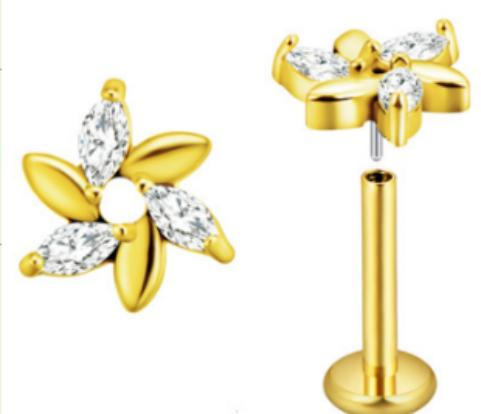
The safest pretty option. A prong set zircon in a modest size suits a lobe, a helix, a conch or a tragus, and it works whether their style is minimal or maximal. In gold or silver tone depending on what they already wear.
A segment clicker
A more generous gift and a more personal one. Rings are the pieces people covet and put off buying for themselves because they cost more. The risk is sizing, so 8mm is the safest diameter if you are guessing, since it suits a helix, a daith and most lobes.
A small set rather than one piece
Two or three pieces that work together is a better gift than one expensive piece in the wrong size, because the odds that at least one fits perfectly go right up. It also suits how people actually wear these, which is as a small collection rather than a single item.
What not to buy
- Anything that does not name its metal standard. If the listing says only hypoallergenic or surgical grade, put it down. Look for ASTM F-136.
- Gold plated over an unnamed base metal. The plating wears and exposes whatever is underneath, usually nickel bearing.
- Butterfly backs. Nobody with piercings wants more of these. They dig in overnight and fall off in bed.
- Anything for a piercing they do not have yet. A gift voucher for a studio is a lovely idea, jewellery for a hypothetical future piercing is not.
- Very large or dangly pieces, unless you know their style. Most people with curated ears wear small things.
- Sterling silver for a piercing. It tarnishes, and tarnish sitting in a piercing channel is not something you want.
If you are shopping for a first piercing
If the gift is for someone about to get their ears done, or a child who has just had theirs done, the metal matters more rather than less. A first piercing is one of the classic moments a lifelong nickel sensitivity gets created, so implant grade titanium is genuinely the kind thing to buy.
It is also worth knowing that a needle piercing at a professional studio heals better than a gun piercing at a kiosk, because guns cannot be properly sterilised and push tissue apart rather than cutting through it. A voucher for a good local studio, plus a piece of titanium to change into later, is a thoughtful pairing. My guide to a first piercing covers what to expect.
Presentation and timing
Two practical notes for Australian buyers. Order earlier than you think for December, because Australia Post gets genuinely slow from late November and tracked parcels are worth the small extra cost when something is time sensitive.
And if the gift is a surprise, remember the piece will probably need swapping for a different size. Including the order number, or simply saying that it can be exchanged, turns an awkward moment into an easy one. Nobody minds a gift that needs sizing. Everyone minds a gift they cannot wear.
The best piercing jewellery gift is the one they can actually put in. Fit beats flourish every time.
Frequently asked questions
What size should I buy if I have no idea?
16 gauge, 8mm, flat back labret, implant grade titanium. That fits more piercings than any other single combination and errs on the comfortable side.
Is titanium a good gift or does it seem cheap?
It is the material professional piercers use, and anyone with piercings will recognise that immediately. It reads as knowledgeable rather than cheap, particularly if you can say it is ASTM F-136.
Can I buy jewellery for a piercing that has just been done?
Yes, but it will not go in for weeks or months. Buy it as something to look forward to and say so, rather than as something to wear now.
What if I get the size wrong?
Check the exchange policy before you buy. Sizing is the normal reason piercing jewellery gets exchanged, and a good seller will expect the question.

Gift ideas by budget
Roughly what you can expect to spend on implant grade titanium in Australia, so you can aim at the right shelf before you start looking.
- Around A$30. A single plain titanium flat back labret or a small single stone stud. Modest on its own, and genuinely useful, because these are the pieces people run out of.
- A$50 to A$70. A pair of studs, or one nicer stone piece, or a single segment clicker. This is the range where a gift starts to feel like a gift.
- A$90 to A$130. A small curated set of three or four pieces that work together, or a clicker plus a couple of studs. The most reliably well received option, because something in it will definitely fit.
- A$150 and up. A larger set, or solid gold if that is their preference. At this level it is worth asking someone who knows their ear rather than guessing.
What about a gift card?
Slightly unfashionable, and for this category genuinely sensible. Piercing jewellery has more variables than almost any other kind, and someone with a curated ear usually has a very clear idea of the exact gap they want to fill. A gift card lets them get the gauge, the length and the style right first time.
If a plain gift card feels impersonal, pair it with something small and physical: a single plain titanium labret they will definitely use, or a bottle of sterile saline, which sounds unromantic and is the thing every pierced person is always out of. The combination reads as thoughtful rather than lazy.
A note on presentation
Piercing jewellery is small, which makes it easy to lose in wrapping paper and easy to underwhelm with. It shows better on a card or in a small pouch than loose in a box, partly because the pieces are tiny and partly because it gives the recipient somewhere to keep them. Anyone with several piercings has a small pile of jewellery migrating around a bathroom shelf, and a pouch genuinely helps.
If you are giving several pieces, laying them out in the order they would be worn up the ear turns a handful of studs into something that looks considered. It costs nothing and it makes a modest gift look like a curated one.
Before you buy
Whoever you buy from, look for a listing that names the metal standard (ASTM F-136 or ASTM F-67 titanium), states the gauge and length or diameter, and says plainly whether any gold colour is PVD or plating. If a seller cannot tell you, buy somewhere else. My guide to checking jewellery is genuinely nickel-free walks through what to look for, and the size guide covers the measurements.
Trusted sources
I only cite organisations that publish their own standards and research, so you can check anything here for yourself.
- Association of Professional Piercers: jewellery for initial piercings
- DermNet: nickel allergy
- Association of Professional Piercers: aftercare guidelines
Gemma
Leave a Reply