

Hoops are what most people picture when they imagine a finished ear. A stud is quiet and a hoop is the thing that makes the whole arrangement look considered. They are also the piece people most often buy too early, in the wrong size, or in a mechanism they end up hating.
This guide covers what to look for in a hoop or clicker for cartilage, how to work out your diameter, and when it is actually safe to wear one. Written for Australian buyers in Australian dollars.
The short answer
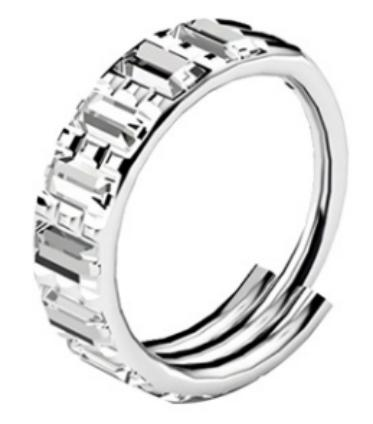
Buy a segment clicker in implant grade titanium, 16 gauge, in a diameter matched to the placement, usually 8mm for a helix and 10mm or 12mm for a conch. Only wear it in a piercing that has been completely calm for months. Rings are for healed cartilage, not healing cartilage.
The three mechanisms, and why clickers win
Captive bead rings
The traditional design: a horseshoe of metal holding a small ball in place by tension. They look clean once in, and they are genuinely difficult to fit without a second pair of hands or a set of ring opening pliers. The ball is small, it is under tension, and it goes flying. Most people who own one have spent time on their knees looking for it.
Seamless rings
A continuous ring that you twist open sideways and twist closed again. Elegant when shut, and the twisting gradually fatigues the metal and distorts the shape, so the ends stop meeting cleanly. Once there is a gap, it catches on hair, and a ring that catches on hair in a cartilage piercing is exactly how irritation starts.
Segment clickers
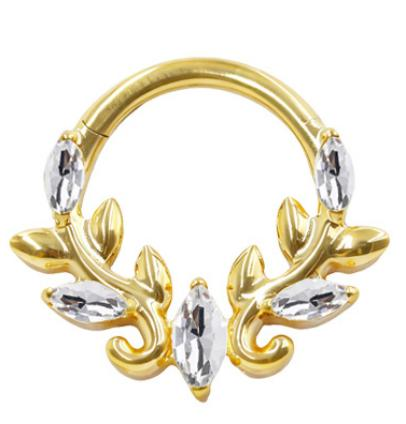
A hinged section that swings open and clicks shut. No loose ball, nothing under tension, no twisting the metal out of shape, and it closes flush so there is no join to catch. You can do it one-handed, which matters when you are working behind your own ear by feel.
Clickers cost more, because a hinge and a flush closure machined into a continuous ring is a harder thing to make well. It is the one place in piercing jewellery where the price difference genuinely buys you a better object rather than just a nicer photo.
Getting the diameter right
Diameter is measured across the inside of the ring, and it is the number people most often guess wrong. A ring that is too small presses on the piercing, restricts circulation and traps discharge where you cannot clean it. Too large and it hangs, swings and catches.
As a rough guide for a healed ear: a helix usually takes 8mm, sometimes 10mm depending on how close to the rim it sits. A conch takes 10mm or 12mm because it has to span the bowl. A daith is usually 8mm. A lobe will take almost anything from 8mm up, which is where you can have some fun with a larger hoop.
Those are starting points, not rules, because ear anatomy varies enormously. If you already own a ring that sits well, measure it. If you do not, ask your piercer, who will tell you in seconds. The size guide shows exactly what is being measured, and my guide to gauges covers thickness.
When can you actually wear one?
This is the part nobody wants to hear. A hoop in healing cartilage is the single most reliable way to give yourself a bump. A ring moves with every turn of your head, it swings, it catches on jumpers and hairbrushes and pillowcases, and each of those tugs drags the healing channel against itself.
Wait until the piercing has been completely calm for several months. No tenderness when pressed, no crusting in the morning, no swelling, no reaction to being slept on. For a helix that is usually somewhere past nine months. For a conch, often a year. The daith is the exception, because its curved anatomy means it is usually pierced with a ring from the start.
If you are counting weeks rather than months, wear a flat back labret and be patient. My guide to jewellery for a fresh helix covers what to wear in the meantime.
The metal question
Everything that applies to studs applies more to rings, because a ring has more surface area against your skin and it moves. Implant grade titanium, ASTM F-136, contains no nickel at all. Surgical steel contains eight to twelve percent, and a moving ring in a cartilage piercing is a demanding environment for any alloy.
Titanium is also around 45 percent lighter than steel, which you notice immediately in a ring. A heavy hoop tugs downward all day, and in cartilage that constant downward pull is its own source of irritation. This is one of the places where the weight difference is not just a talking point.
What makes a well made clicker
- The closure sits flush. Run a fingernail over the join. You should barely feel it.
- The hinge is firm. It should click decisively, not flop. A loose hinge means a ring that opens in your hair.
- The inside is polished. The surface that sits in your piercing matters more than the one on show.
- The gauge is consistent. A ring that thickens near the hinge is a badly finished one.
- The stones are set, not glued. Prong or bezel set. Glue fails in showers and it does not belong in body jewellery.
Frequently asked questions
What size hoop for a helix?
8mm suits most helixes, with 10mm for placements further from the rim. If it looks like it is straining or standing away from the ear, it is the wrong size.
Can I sleep in a hoop?
In a healed lobe, most people do. In cartilage I would not, because it is the easiest way to catch or bend a piece overnight. My guide to what to sleep in covers the alternative.
Do clickers hurt to put in?
In a healed piercing, no. There is a moment of finding the channel and then it slides through. If it hurts, either the piercing is not as healed as you thought or the gauge is wrong.
How many hoops should one ear have?
Fewer than you think, usually. One or two rings among a set of studs reads as considered. Four rings reads as busy. My guide to building a curated ear covers balance.
What clickers cost in Australia
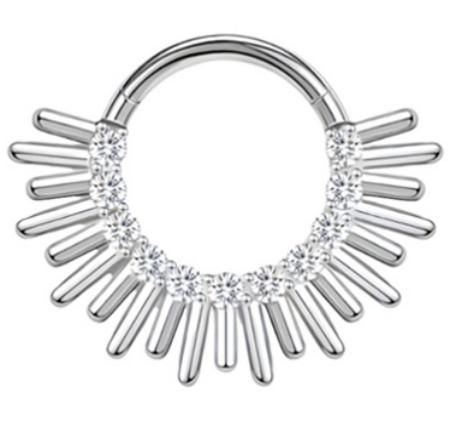
A titanium segment clicker from a seller who names their standard generally runs A$40 to A$60, and plain designs sit at the lower end while set stones push it up. That is roughly a third more than a comparable stud, and the difference is real manufacturing rather than markup: a hinge, a sprung closure and a continuous polished ring are considerably harder to produce than a straight post with a disc on one end.
The cheap end, ten to twenty dollars, is steel or unspecified alloy with a mechanism to match. Cheap clickers are where you find the loose hinges and the closures that sit proud, and both of those are the specific failure modes that make a ring catch on hair.
If you are building a collection, buy the diameters you actually wear rather than a variety. Most people end up wearing one or two sizes across their whole ear, and a drawer of rings that do not fit anything is a common and expensive mistake.
Changing a clicker without losing it
Rings are more fiddly than studs, and the difference between an easy change and a frustrating one is mostly setup. Do it sitting down, over a towel on a table rather than over a sink, with a mirror you can angle. A ring that drops onto a towel stays where it fell. A ring that drops into a basin is gone.
Open the hinge before you bring it near your ear, find the piercing channel with the fixed end rather than the hinged one, and let the ring follow its own curve through rather than forcing it straight. If you meet resistance, stop and re-angle instead of pushing. Wash your hands first, and if the piercing is anywhere you cannot see properly, such as a daith or a conch, it is entirely reasonable to have a piercer do it.
Styling hoops in a curated ear
Rings are the loudest thing in an ear, so they work best when they are outnumbered. A common structure is one ring as the anchor, usually in a conch or a lower helix, with studs filling everything around it. Two rings can work if they are separated by a few placements, so the eye reads them as a pair rather than a cluster.
Diameter is a styling decision as well as a fit one. Rings of noticeably different sizes in adjacent placements tend to look accidental, while keeping them the same size, or stepping them deliberately from small at the top to larger at the lobe, reads as intentional. My guide to building a curated ear covers the wider arrangement, and ear piercing placements covers what sits where.
Before you buy
Whoever you buy from, look for a listing that names the metal standard (ASTM F-136 or ASTM F-67 titanium), states the gauge and length or diameter, and says plainly whether any gold colour is PVD or plating. If a seller cannot tell you, buy somewhere else. My guide to checking jewellery is genuinely nickel-free walks through what to look for, and the size guide covers the measurements.
Trusted sources
I only cite organisations that publish their own standards and research, so you can check anything here for yourself.
- Association of Professional Piercers: jewellery for initial piercings
- DermNet: nickel allergy
- Association of Professional Piercers: aftercare guidelines
Gemma
Leave a Reply