
Author: willowandthorn

  • A piercing jewellery gift guide for Australia

    A piercing jewellery gift guide for Australia

    Piercing jewellery is a lovely gift and an easy one to get wrong, because unlike most jewellery it has to fit. A necklace is one size. A labret has a gauge, a length, a back and a mechanism, and the wrong combination sits in a drawer forever. The good news is that there are a handful of choices that are almost impossible to get wrong, and a few simple questions that make the rest easy.

    This is a practical gift guide for buying piercing jewellery in Australia, written for people who do not have piercings themselves and are shopping for someone who does.
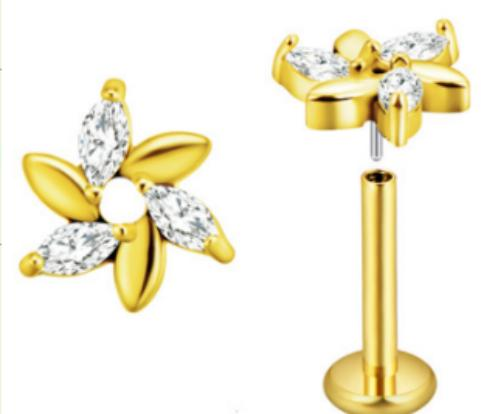
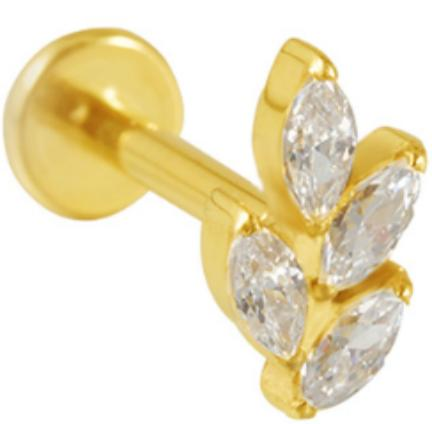
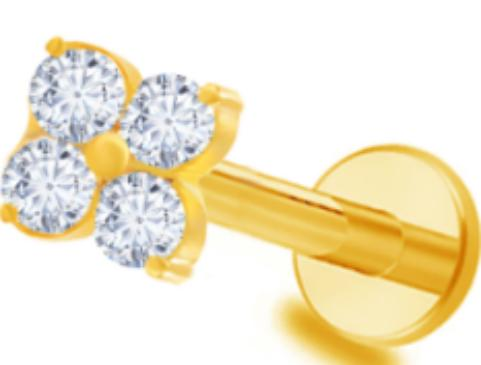
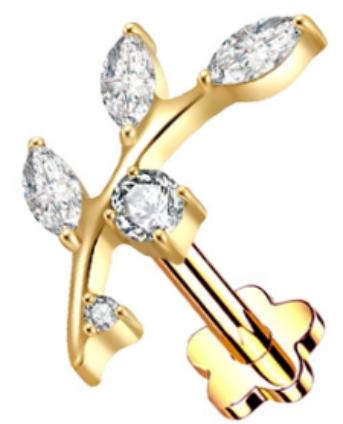
    A gold zircon flat back labret stud in implant grade titanium, presented as a gift

    If you know nothing about their piercings

    Buy implant grade titanium, in a flat back labret, 16 gauge, 8mm long. That combination fits more piercings than any other single specification, it is the standard most Australian piercers use, and a slightly long post is far more comfortable than a slightly short one. If you buy one thing blind, buy that.

    Better still, buy a piece and include the receipt or a note that it can be exchanged for a different size. Anyone with piercings will understand immediately and will appreciate that you thought about it.

    The three questions that make this easy

    If you can ask casually without ruining the surprise, these three answers let you buy exactly the right thing.

    • What gauge do you wear? Almost always 16g or 18g. 16g is the common one for cartilage, 18g for lobes.
    • What length? 6mm or 8mm covers nearly everyone. 6mm for a settled piercing, 8mm for a newer one or a thicker ear.
    • Gold or silver tone? Most people have a clear preference and stick to it.

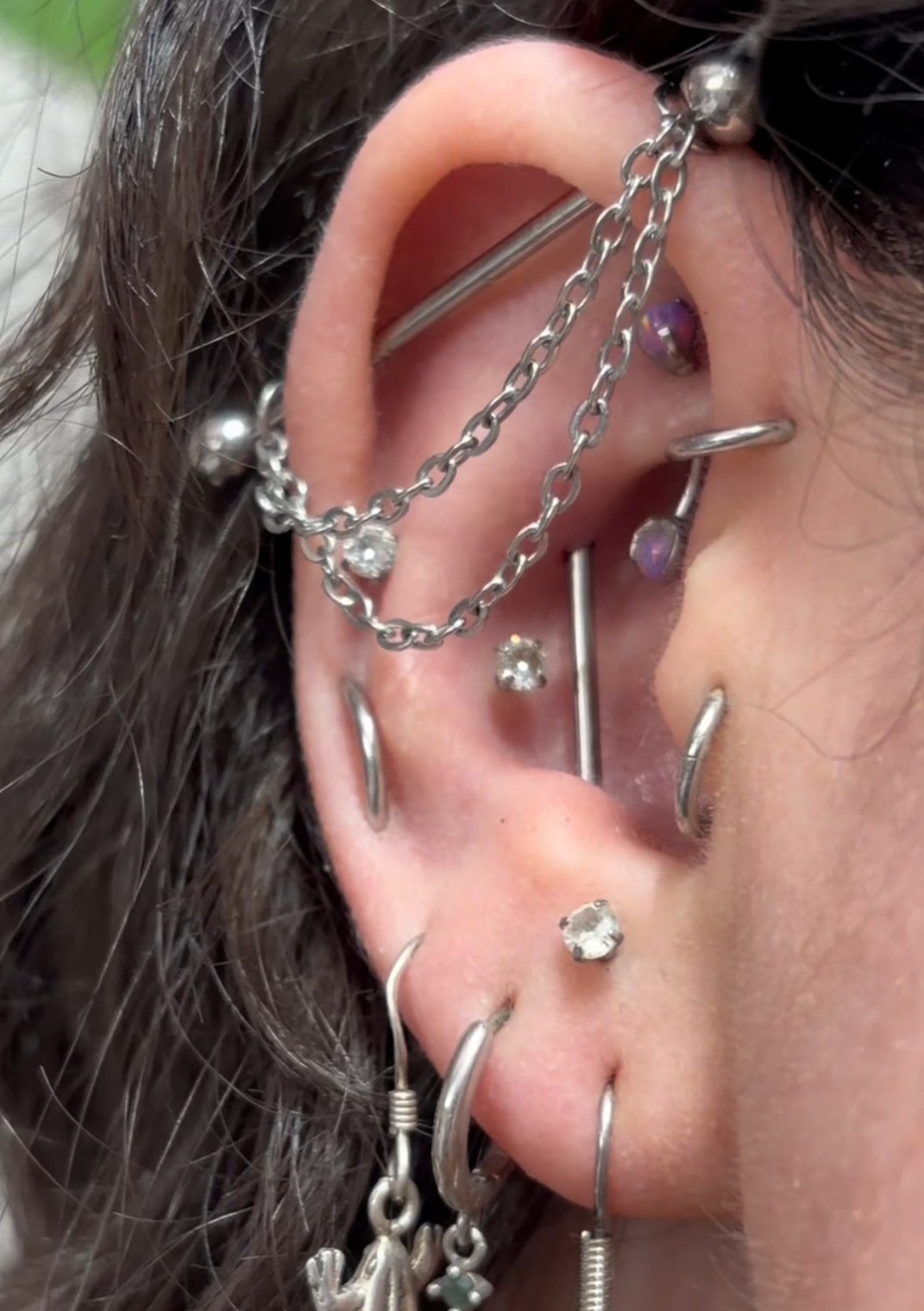
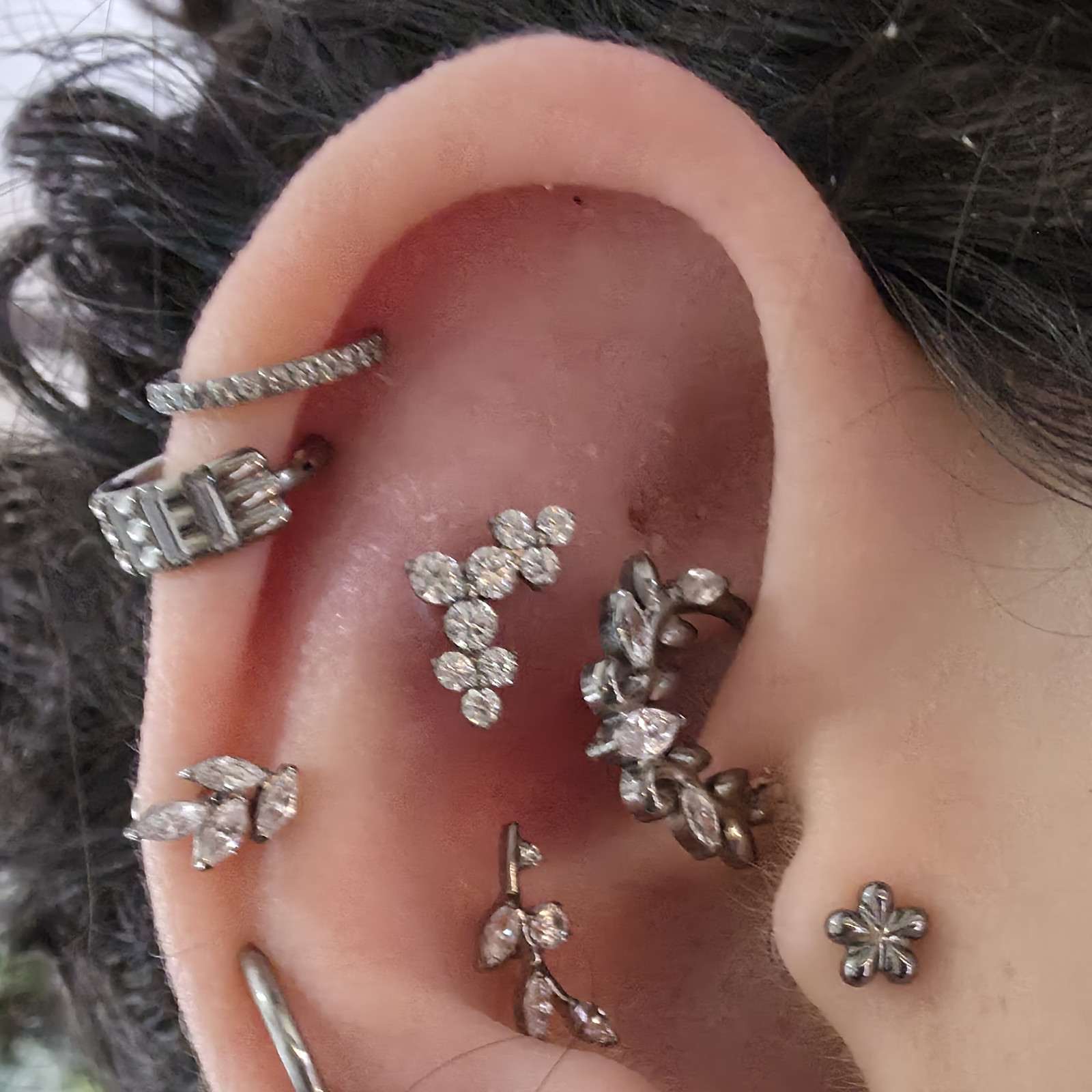
    If asking directly is impossible, look at what they already wear. A photo of their ear, zoomed in, tells a piercer or a good seller almost everything they need to know.

    Gifts that are hard to get wrong

    A plain titanium flat back labret

    The workhorse. Everyone with piercings needs more of these than they own, they suit every placement, and they are what people wear when they want something that disappears. Unglamorous as a gift on its own, excellent as part of a set.

    A single stone stud

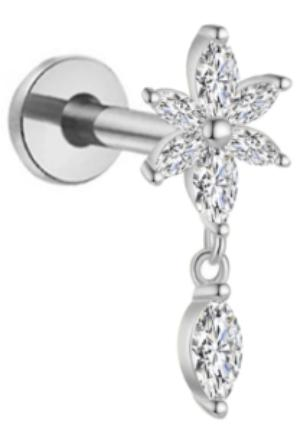
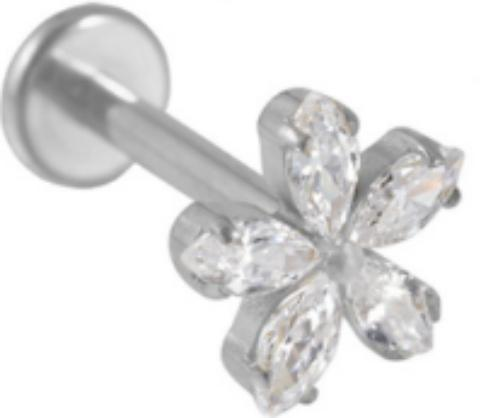
    The safest pretty option. A prong set zircon in a modest size suits a lobe, a helix, a conch or a tragus, and it works whether their style is minimal or maximal. In gold or silver tone depending on what they already wear.

    A segment clicker

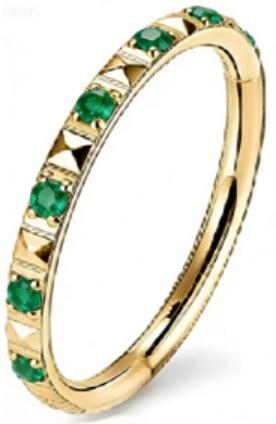
    A more generous gift and a more personal one. Rings are the pieces people covet and put off buying for themselves because they cost more. The risk is sizing, so 8mm is the safest diameter if you are guessing, since it suits a helix, a daith and most lobes.

    A small set rather than one piece

    Two or three pieces that work together is a better gift than one expensive piece in the wrong size, because the odds that at least one fits perfectly go right up. It also suits how people actually wear these, which is as a small collection rather than a single item.
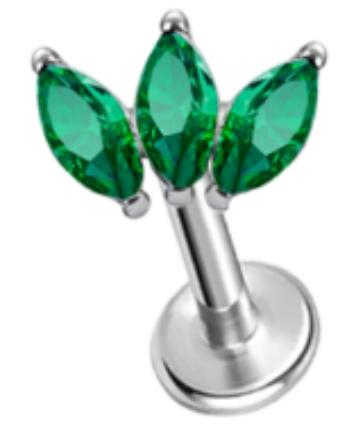
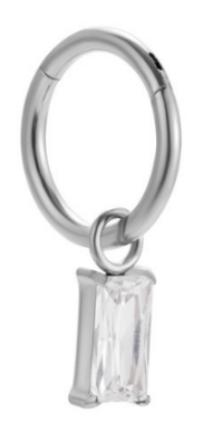
    A silver zircon threadless labret stud in implant grade titanium by Willow and Thorn

    What not to buy

    • Anything that does not name its metal standard. If the listing says only hypoallergenic or surgical grade, put it down. Look for ASTM F-136.
    • Gold plated over an unnamed base metal. The plating wears and exposes whatever is underneath, usually nickel bearing.
    • Butterfly backs. Nobody with piercings wants more of these. They dig in overnight and fall off in bed.
    • Anything for a piercing they do not have yet. A gift voucher for a studio is a lovely idea, jewellery for a hypothetical future piercing is not.
    • Very large or dangly pieces, unless you know their style. Most people with curated ears wear small things.
    • Sterling silver for a piercing. It tarnishes, and tarnish sitting in a piercing channel is not something you want.

    If you are shopping for a first piercing

    If the gift is for someone about to get their ears done, or a child who has just had theirs done, the metal matters more rather than less. A first piercing is one of the classic moments a lifelong nickel sensitivity gets created, so implant grade titanium is genuinely the kind thing to buy.

    It is also worth knowing that a needle piercing at a professional studio heals better than a gun piercing at a kiosk, because guns cannot be properly sterilised and push tissue apart rather than cutting through it. A voucher for a good local studio, plus a piece of titanium to change into later, is a thoughtful pairing. My guide to a first piercing covers what to expect.

    Presentation and timing

    Two practical notes for Australian buyers. Order earlier than you think for December, because Australia Post gets genuinely slow from late November and tracked parcels are worth the small extra cost when something is time sensitive.

    And if the gift is a surprise, remember the piece will probably need swapping for a different size. Including the order number, or simply saying that it can be exchanged, turns an awkward moment into an easy one. Nobody minds a gift that needs sizing. Everyone minds a gift they cannot wear.

    The best piercing jewellery gift is the one they can actually put in. Fit beats flourish every time.

    Frequently asked questions

    What size should I buy if I have no idea?

    16 gauge, 8mm, flat back labret, implant grade titanium. That fits more piercings than any other single combination and errs on the comfortable side.

    Is titanium a good gift or does it seem cheap?

    It is the material professional piercers use, and anyone with piercings will recognise that immediately. It reads as knowledgeable rather than cheap, particularly if you can say it is ASTM F-136.

    Can I buy jewellery for a piercing that has just been done?

    Yes, but it will not go in for weeks or months. Buy it as something to look forward to and say so, rather than as something to wear now.

    What if I get the size wrong?

    Check the exchange policy before you buy. Sizing is the normal reason piercing jewellery gets exchanged, and a good seller will expect the question.

    Willow branches, the Willow and Thorn brand imagery

    Gift ideas by budget

    Roughly what you can expect to spend on implant grade titanium in Australia, so you can aim at the right shelf before you start looking.

    • Around A$30. A single plain titanium flat back labret or a small single stone stud. Modest on its own, and genuinely useful, because these are the pieces people run out of.
    • A$50 to A$70. A pair of studs, or one nicer stone piece, or a single segment clicker. This is the range where a gift starts to feel like a gift.
    • A$90 to A$130. A small curated set of three or four pieces that work together, or a clicker plus a couple of studs. The most reliably well received option, because something in it will definitely fit.
    • A$150 and up. A larger set, or solid gold if that is their preference. At this level it is worth asking someone who knows their ear rather than guessing.

    What about a gift card?

    Slightly unfashionable, and for this category genuinely sensible. Piercing jewellery has more variables than almost any other kind, and someone with a curated ear usually has a very clear idea of the exact gap they want to fill. A gift card lets them get the gauge, the length and the style right first time.

    If a plain gift card feels impersonal, pair it with something small and physical: a single plain titanium labret they will definitely use, or a bottle of sterile saline, which sounds unromantic and is the thing every pierced person is always out of. The combination reads as thoughtful rather than lazy.

    A note on presentation

    Piercing jewellery is small, which makes it easy to lose in wrapping paper and easy to underwhelm with. It shows better on a card or in a small pouch than loose in a box, partly because the pieces are tiny and partly because it gives the recipient somewhere to keep them. Anyone with several piercings has a small pile of jewellery migrating around a bathroom shelf, and a pouch genuinely helps.

    If you are giving several pieces, laying them out in the order they would be worn up the ear turns a handful of studs into something that looks considered. It costs nothing and it makes a modest gift look like a curated one.

    Before you buy

    Whoever you buy from, look for a listing that names the metal standard (ASTM F-136 or ASTM F-67 titanium), states the gauge and length or diameter, and says plainly whether any gold colour is PVD or plating. If a seller cannot tell you, buy somewhere else. My guide to checking jewellery is genuinely nickel-free walks through what to look for, and the size guide covers the measurements.

    Trusted sources

    I only cite organisations that publish their own standards and research, so you can check anything here for yourself.

    Gemma
  • Best hoops and clickers for cartilage piercings in Australia

    Best hoops and clickers for cartilage piercings in Australia

    Hoops are what most people picture when they imagine a finished ear. A stud is quiet and a hoop is the thing that makes the whole arrangement look considered. They are also the piece people most often buy too early, in the wrong size, or in a mechanism they end up hating.

    This guide covers what to look for in a hoop or clicker for cartilage, how to work out your diameter, and when it is actually safe to wear one. Written for Australian buyers in Australian dollars.

    A silver zircon segment clicker ring in implant grade titanium by Willow and Thorn

    The short answer

    Buy a segment clicker in implant grade titanium, 16 gauge, in a diameter matched to the placement, usually 8mm for a helix and 10mm or 12mm for a conch. Only wear it in a piercing that has been completely calm for months. Rings are for healed cartilage, not healing cartilage.

    The three mechanisms, and why clickers win

    Captive bead rings

    The traditional design: a horseshoe of metal holding a small ball in place by tension. They look clean once in, and they are genuinely difficult to fit without a second pair of hands or a set of ring opening pliers. The ball is small, it is under tension, and it goes flying. Most people who own one have spent time on their knees looking for it.

    Seamless rings

    A continuous ring that you twist open sideways and twist closed again. Elegant when shut, and the twisting gradually fatigues the metal and distorts the shape, so the ends stop meeting cleanly. Once there is a gap, it catches on hair, and a ring that catches on hair in a cartilage piercing is exactly how irritation starts.

    Segment clickers

    A hinged section that swings open and clicks shut. No loose ball, nothing under tension, no twisting the metal out of shape, and it closes flush so there is no join to catch. You can do it one-handed, which matters when you are working behind your own ear by feel.

    Clickers cost more, because a hinge and a flush closure machined into a continuous ring is a harder thing to make well. It is the one place in piercing jewellery where the price difference genuinely buys you a better object rather than just a nicer photo.

    Getting the diameter right

    Diameter is measured across the inside of the ring, and it is the number people most often guess wrong. A ring that is too small presses on the piercing, restricts circulation and traps discharge where you cannot clean it. Too large and it hangs, swings and catches.

    As a rough guide for a healed ear: a helix usually takes 8mm, sometimes 10mm depending on how close to the rim it sits. A conch takes 10mm or 12mm because it has to span the bowl. A daith is usually 8mm. A lobe will take almost anything from 8mm up, which is where you can have some fun with a larger hoop.

    Those are starting points, not rules, because ear anatomy varies enormously. If you already own a ring that sits well, measure it. If you do not, ask your piercer, who will tell you in seconds. The size guide shows exactly what is being measured, and my guide to gauges covers thickness.

    A gold zircon segment clicker ring in nickel free implant grade titanium

    When can you actually wear one?

    This is the part nobody wants to hear. A hoop in healing cartilage is the single most reliable way to give yourself a bump. A ring moves with every turn of your head, it swings, it catches on jumpers and hairbrushes and pillowcases, and each of those tugs drags the healing channel against itself.

    Wait until the piercing has been completely calm for several months. No tenderness when pressed, no crusting in the morning, no swelling, no reaction to being slept on. For a helix that is usually somewhere past nine months. For a conch, often a year. The daith is the exception, because its curved anatomy means it is usually pierced with a ring from the start.

    If you are counting weeks rather than months, wear a flat back labret and be patient. My guide to jewellery for a fresh helix covers what to wear in the meantime.

    The metal question

    Everything that applies to studs applies more to rings, because a ring has more surface area against your skin and it moves. Implant grade titanium, ASTM F-136, contains no nickel at all. Surgical steel contains eight to twelve percent, and a moving ring in a cartilage piercing is a demanding environment for any alloy.

    Titanium is also around 45 percent lighter than steel, which you notice immediately in a ring. A heavy hoop tugs downward all day, and in cartilage that constant downward pull is its own source of irritation. This is one of the places where the weight difference is not just a talking point.

    What makes a well made clicker

    • The closure sits flush. Run a fingernail over the join. You should barely feel it.
    • The hinge is firm. It should click decisively, not flop. A loose hinge means a ring that opens in your hair.
    • The inside is polished. The surface that sits in your piercing matters more than the one on show.
    • The gauge is consistent. A ring that thickens near the hinge is a badly finished one.
    • The stones are set, not glued. Prong or bezel set. Glue fails in showers and it does not belong in body jewellery.

    Frequently asked questions

    What size hoop for a helix?

    8mm suits most helixes, with 10mm for placements further from the rim. If it looks like it is straining or standing away from the ear, it is the wrong size.

    Can I sleep in a hoop?

    In a healed lobe, most people do. In cartilage I would not, because it is the easiest way to catch or bend a piece overnight. My guide to what to sleep in covers the alternative.

    Do clickers hurt to put in?

    In a healed piercing, no. There is a moment of finding the channel and then it slides through. If it hurts, either the piercing is not as healed as you thought or the gauge is wrong.

    How many hoops should one ear have?

    Fewer than you think, usually. One or two rings among a set of studs reads as considered. Four rings reads as busy. My guide to building a curated ear covers balance.

    A silver zircon segment clicker ring in implant grade titanium by Willow and Thorn

    What clickers cost in Australia

    A titanium segment clicker from a seller who names their standard generally runs A$40 to A$60, and plain designs sit at the lower end while set stones push it up. That is roughly a third more than a comparable stud, and the difference is real manufacturing rather than markup: a hinge, a sprung closure and a continuous polished ring are considerably harder to produce than a straight post with a disc on one end.

    The cheap end, ten to twenty dollars, is steel or unspecified alloy with a mechanism to match. Cheap clickers are where you find the loose hinges and the closures that sit proud, and both of those are the specific failure modes that make a ring catch on hair.

    If you are building a collection, buy the diameters you actually wear rather than a variety. Most people end up wearing one or two sizes across their whole ear, and a drawer of rings that do not fit anything is a common and expensive mistake.

    Changing a clicker without losing it

    Rings are more fiddly than studs, and the difference between an easy change and a frustrating one is mostly setup. Do it sitting down, over a towel on a table rather than over a sink, with a mirror you can angle. A ring that drops onto a towel stays where it fell. A ring that drops into a basin is gone.

    Open the hinge before you bring it near your ear, find the piercing channel with the fixed end rather than the hinged one, and let the ring follow its own curve through rather than forcing it straight. If you meet resistance, stop and re-angle instead of pushing. Wash your hands first, and if the piercing is anywhere you cannot see properly, such as a daith or a conch, it is entirely reasonable to have a piercer do it.

    Styling hoops in a curated ear

    Rings are the loudest thing in an ear, so they work best when they are outnumbered. A common structure is one ring as the anchor, usually in a conch or a lower helix, with studs filling everything around it. Two rings can work if they are separated by a few placements, so the eye reads them as a pair rather than a cluster.

    Diameter is a styling decision as well as a fit one. Rings of noticeably different sizes in adjacent placements tend to look accidental, while keeping them the same size, or stepping them deliberately from small at the top to larger at the lobe, reads as intentional. My guide to building a curated ear covers the wider arrangement, and ear piercing placements covers what sits where.

    Before you buy

    Whoever you buy from, look for a listing that names the metal standard (ASTM F-136 or ASTM F-67 titanium), states the gauge and length or diameter, and says plainly whether any gold colour is PVD or plating. If a seller cannot tell you, buy somewhere else. My guide to checking jewellery is genuinely nickel-free walks through what to look for, and the size guide covers the measurements.

    Trusted sources

    I only cite organisations that publish their own standards and research, so you can check anything here for yourself.

    Gemma

  • 18K gold PVD, gold plated or solid gold: which should you buy?

    18K gold PVD, gold plated or solid gold: which should you buy?

    Gold jewellery is sold in Australia under at least five different descriptions, most of which are designed to sound like solid gold without being it. Gold plated, gold filled, gold vermeil, PVD gold, solid gold. They are wildly different products at wildly different prices, they wear in completely different ways, and only some of them are safe to put in a piercing.

    This guide explains what each one actually is, how long it lasts, and which to buy. I don’t sell jewellery, so this is the straight version of what each finish will and will not do, including gold PVD over titanium.

    A gold zircon threadless labret stud in implant grade titanium with 18K gold PVD finish

    The short answer

    For a piercing, buy either solid gold at 14K or 18K, or gold PVD over implant grade titanium. Avoid gold plated and gold vermeil in anything that goes through your skin, and treat gold filled as acceptable for earrings that sit on the outside but not for a healing piercing. The thing that matters is not the gold. It is what is underneath it.

    The five kinds of gold, plainly

    Solid gold

    Gold all the way through, alloyed with other metals for hardness. 14K is 58 percent gold, 18K is 75 percent. It never wears off, because there is no coating to wear. It is also the most expensive by a long way, and it is heavy, which some people love and some notice by the end of the day.

    The catch is the alloy. Pure gold is far too soft, so it is always mixed with something, and in cheaper gold that something can include nickel. White gold in particular is often alloyed with nickel to achieve the colour. If you are buying solid gold and you have sensitive ears, ask what the alloy contains. A good jeweller will tell you.

    Gold filled

    A thick layer of gold mechanically bonded to a base metal core, legally required to be at least five percent gold by weight. It is far more substantial than plating and can last years on an item worn outside the skin. It is a genuinely decent product for earrings, chains and bracelets.

    It is still a layer over a base metal, though, and the base is usually brass. For a piercing that sits in an open channel, I would not use it.

    Gold vermeil

    Gold plating over sterling silver, with a minimum thickness required to use the name. Better than ordinary plating because the base is silver rather than brass, so there is no nickel underneath. But the plating is still thin, silver tarnishes once exposed, and vermeil does not cope well with moisture. Fine for occasional wear, poor for a piercing you sleep in.

    Gold plated

    A microscopically thin layer of gold deposited on a base metal, often measured in fractions of a micron. This is what most cheap gold coloured jewellery is. It wears through quickly, sometimes in weeks, and what is underneath is usually brass or a nickel bearing alloy. In a piercing this is the worst option available, because the moment the plating wears you have nickel sitting in an open wound.

    Gold PVD

    Physical vapour deposition. The piece goes into a vacuum chamber and a gold coloured material is vaporised and bonded to the surface at a molecular level. The result is far harder and far more scratch resistant than electroplating, and it does not flake. It is the same process used on high end watch cases and surgical tools.

    PVD is still a surface finish rather than solid gold, so it will eventually wear at high friction points. The reason it works for piercing jewellery is what sits underneath. When PVD is applied over implant grade titanium, a worn patch exposes more titanium, which is nickel free and completely safe. When it is applied over steel, a worn patch exposes nickel.

    A gold zircon segment clicker ring in implant grade titanium with PVD gold finish

    How long gold PVD over titanium lasts

    The most honest way to describe this finish is the long way: 18K gold PVD over ASTM F-136 implant grade titanium. Good sellers describe it exactly like that, rather than just calling it gold, because the difference matters.

    Expect it to keep its colour for a few years of normal daily wear rather than forever. Anyone selling a plated finish at this price point and promising it lasts a lifetime is either using solid gold or guessing. PVD is hard, but it is not permanent, and how long yours lasts depends on where the piece sits and how much friction it gets.

    What you can count on is that when it does eventually wear, nothing harmful is exposed, because the base is titanium rather than steel. That is the whole point of choosing titanium underneath.

    How to make gold last longer

    • Take it off for the pool and the ocean. Chlorine and salt are hard on any finish.
    • Put jewellery on last. Perfume, hairspray, sunscreen and fake tan all attack plating and PVD.
    • Do not scrub it. Warm water, a drop of mild soap and a soft cloth. No polishing cloths, which are abrasive and designed to remove a surface layer.
    • Avoid ultrasonic cleaners. They are fine for solid metal and unkind to finishes.
    • Rotate your pieces. The piece you wear every single day wears fastest. A small collection lasts longer than one favourite.
    • Wear the unplated titanium while healing. Bare metal is the safest thing for an open piercing, and it saves the gold from the roughest months.

    Is gold worth it for a piercing?

    If you mean solid gold, it is worth it when you want something permanent and you have the budget, and it is the only option that genuinely never changes. Expect to pay several times what titanium costs for the same shape.

    If you mean PVD gold over titanium, yes, with clear eyes. You are buying the colour and the look, on a piece whose safety does not depend on the finish surviving. You will probably want to replace it in a few years, which is worth factoring in. Many people buy titanium in silver tone for the pieces they never take out, and gold for the visible statement pieces they change more often. That is a sensible way to split a budget.

    What is never worth it for a piercing is gold plating over an unspecified base metal, no matter how good the photo looks or how low the price is.

    A gold flat back labret stud in implant grade titanium by Willow and Thorn

    Frequently asked questions

    Will PVD gold turn my ear green?

    No. Green staining comes from copper in cheap alloys reacting with skin. There is no copper in implant grade titanium and none in the PVD layer.

    Can I wear gold in a healing piercing?

    I would not. Bare implant grade titanium is the safest thing for an open wound, and healing is the period of heaviest wear on any finish. Wear titanium for the first few months and switch to gold once it has settled.

    Is 18K PVD the same as 18K gold?

    No, and it is worth being clear about. 18K describes the colour and tone of the finish, not the composition of the whole piece. The piece is titanium with a gold coloured surface. Anyone implying otherwise is being slippery.

    Does PVD wear evenly?

    Mostly, but high friction points go first. On a labret that tends to be the edge of the disc where it sits against the skin, which is the part nobody sees. Visible tops usually keep their colour longest.

    Can I mix gold and silver tone pieces?

    Absolutely, and it looks intentional when it is done with a bit of structure. My guide to mixing gold and silver covers how to keep a two-tone ear looking deliberate.

    How to read a gold listing in Australia

    Most of the confusion in this category is deliberate, so it helps to know the tells. A listing that says gold tone, gold colour or gold finish is telling you there is no meaningful gold content at all. A listing that says 18K without the words solid or PVD is usually describing the colour of a coating rather than the composition of the piece. Anything that says gold over stainless steel is telling you the base is nickel bearing, whether or not it puts it that way.

    What an honest listing looks like is specific and slightly less exciting. It names the base metal and its standard, it names the finish and the process, and it does not promise permanence. A good one reads something like 18K gold PVD on ASTM F-136 implant grade titanium, which is a mouthful and is exactly the point.

    One more test worth applying: if the seller quotes a plating thickness in microns, they probably know what they are selling. If they cannot answer what is underneath the gold, that is your answer.

    A word on white gold

    White gold deserves its own warning if you have sensitive ears. Gold is naturally yellow, so white gold is made by alloying it with a white metal, and historically that metal has very often been nickel. It is then usually rhodium plated on top to get the bright white finish, and when that rhodium wears, which it does, you meet the alloy underneath.

    This catches people out because white gold feels like a premium purchase, and premium is not the same as nickel free. If you want a silver tone in a piercing and you react to things, implant grade titanium is the straightforward answer. Palladium white gold exists and is nickel free, but you have to ask, and it costs considerably more.

    Before you buy

    Whoever you buy from, look for a listing that names the metal standard (ASTM F-136 or ASTM F-67 titanium), states the gauge and length or diameter, and says plainly whether any gold colour is PVD or plating. If a seller cannot tell you, buy somewhere else. My guide to checking jewellery is genuinely nickel-free walks through what to look for, and the size guide covers the measurements.

    Trusted sources

    I only cite organisations that publish their own standards and research, so you can check anything here for yourself.

    Gemma

  • Best daith piercing jewellery in Australia

    Best daith piercing jewellery in Australia

    The daith is the small fold of cartilage that curves over the entrance to your ear canal. A ring through it sits in a way no other piercing does, tucked inside the ear rather than around its edge, which is why it has become one of the most requested piercings in Australia. It is also one of the trickiest to buy jewellery for, because the shape of the fold does most of the deciding.

    This guide covers what to wear in a daith, how to work out what diameter you need, and the honest answer to the migraine question. Australian buyers, Australian dollars.

    A silver zircon segment clicker ring in implant grade titanium, suitable for a daith piercing

    The short answer

    A daith is one of the few piercings usually done with a ring from the start, because a straight bar does not sit well in a curved fold. Buy an implant grade titanium clicker in 16 gauge, in a diameter that matches your anatomy, most commonly 8mm. Have your piercer size it rather than guessing, because a daith ring that is slightly wrong is uncomfortable in a way that is hard to ignore.

    Why the daith is different

    Most cartilage piercings are best started with a flat back labret so that nothing moves. The daith is the exception. It passes through a curved fold, and a straight post through a curve either presses at both ends or sits at an angle, neither of which is comfortable. A curved piece that follows the fold is the better fit, which is why most piercers use a ring or a curved barbell from day one.

    That does mean a daith has a ring in it while healing, which brings all the usual ring problems: movement, catching, and pressure. It is one reason daiths can be slow, often taking six to twelve months. It is also why getting the diameter right matters so much.

    Getting the diameter right

    This is the whole game with a daith. Too small and the ring presses against the fold, restricts blood flow and traps discharge where you cannot clean it. Too large and it hangs loose, swings when you move, and catches on everything.

    Most daiths take an 8mm ring. Some anatomy needs 10mm, and smaller ears sometimes take 6mm. There is no way to work this out reliably from a photo of someone else’s ear, because the fold varies enormously between people. If you were pierced professionally, ask what diameter you are wearing and write it down, because it is the number you will need every time you buy.

    Gauge is more consistent: 16 gauge, which is 1.2mm, is standard in Australia. My guide to gauges explains the numbering if it is unfamiliar.

    Clicker or captive bead?

    A captive bead ring is the older style, a horseshoe of metal holding a ball by tension. They work, they are cheap, and they are genuinely awful to change, because the ball pings across the room at the worst moment. In a daith, which is tucked inside the ear and hard to see, this is worse again.

    A segment clicker is a single piece of titanium with a hinged section that clicks shut. Nothing to drop, nothing to lose, no gap where the join is, and it can be done one-handed. For a daith specifically, where you are working in an awkward spot largely by feel, this is a meaningful difference.

    A gold zircon segment clicker ring in implant grade titanium by Willow and Thorn

    The metal question

    A daith heals slowly and sits in a fold that traps moisture, sweat and hair product. That combination, months of contact in a warm damp spot, is about the most demanding thing you can ask of a metal. Implant grade titanium, ASTM F-136, contains no nickel, does not corrode and does not tarnish, which is why it is the standard for this.

    Avoid gold plated pieces while healing. Plating is a surface layer, and a daith is exactly the environment where a surface layer gets tested. Gold PVD over titanium is the better option, since a worn spot exposes only more titanium, but for a fresh daith I would still wear plain titanium and save the gold for later.

    The migraine question, honestly

    You will have seen the claim that a daith piercing relieves migraines. It is the reason a lot of people book one, so it deserves a straight answer rather than either a sales pitch or a dismissal.

    The theory borrows from acupuncture, on the idea that the daith sits near a pressure point associated with headache relief. The evidence is genuinely weak. What exists is mostly case reports and surveys rather than controlled trials, and the studies that have looked at it carefully tend to attribute the improvement people report to the placebo effect, which is powerful and well documented for pain conditions.

    So my position is this: get a daith because you like how it looks, which is an excellent reason. If your migraines improve, that is a lovely bonus. Please do not stop any treatment your doctor has prescribed on the strength of a piercing, and if you get migraines regularly, that is a conversation for your GP rather than a piercing studio.

    Buy a daith for the way it looks. Anything else it does for you is a bonus, not a plan.

    Healing a daith

    Sterile saline twice a day, then leave it completely alone. The daith is tucked inside the ear, so rinsing thoroughly matters more here than elsewhere, because discharge and product can collect in the fold where you cannot see it. Let the water from the shower run through the ear and dry it gently afterwards.

    The two things most likely to irritate a daith are sleeping on that side and earphones. In-ear buds sit directly against a healing daith, so switch to over-ear headphones while it settles, which is the opposite of the advice for a conch. If you have both piercings healing at once, you have my sympathy and you should probably use speakers.

    The full aftercare guide covers the routine, and if a bump appears, my guide to piercing bumps explains what is usually causing it. Do not remove the jewellery at the first sign of trouble.

    A plain silver segment clicker ring in implant grade titanium by Willow and Thorn

    Frequently asked questions

    Does a daith piercing hurt?

    More than a lobe, comparable to other cartilage piercings, and over quickly. The fold is thick, so there is a firm pressure rather than a sharp sting. Most people describe the pinch as brief and the ache afterwards as the harder part.

    What size ring for a daith?

    8mm suits most people, with 6mm and 10mm covering the rest. Ask your piercer for your diameter rather than guessing, because a daith ring that is even a millimetre out is noticeably uncomfortable.

    Can I wear a curved barbell instead?

    Yes, and some piercers prefer them for healing because they sit snugly and have less to catch on. A ring is the classic look, a curved barbell is the practical one. Both are fine in implant grade titanium.

    How long until I can change it?

    Six to twelve months, and only once it has been completely calm for a stretch. Because a daith is awkward to reach, it is worth having your piercer do the first change rather than fighting with it in front of a mirror.

    What daith jewellery costs in Australia

    A titanium clicker from a seller who can name their standard generally runs A$40 to A$60. Clickers cost more than studs because the hinge and the seamless closure are machined into one continuous ring, which is a genuinely harder piece to make well. A poorly made clicker shows it immediately: the closure sits proud, you can feel the join with a fingernail, and it catches on hair.

    The cheap end, ten to twenty dollars, is steel or unspecified alloy. That is a bad trade in a daith specifically, because this is a slow healing piercing in a warm damp fold, which is the hardest test you can give a metal.

    Buy at least two once you are healed. A daith is awkward to reach and fiddly to change, so most people settle on one piece they wear more or less permanently. Having a spare means a lost or damaged ring is not a crisis.

    Styling a daith

    A daith sits inside the ear rather than on its edge, which makes it one of the few piercings that reads as subtle and dramatic at once. From straight on it is barely visible. In profile it frames the ear canal and becomes the focal point of the whole ear.

    Because it sits low and inward, a daith rarely competes with anything else, so it layers happily with a full helix or a stacked lobe. The one pairing to think about is a daith and a conch together, since both are rings in the middle of the ear and two rings that close to each other can read as busy. If you want both, a smaller daith ring with a conch stud usually balances better. My guide to ear piercing placements covers how the two sit together.

    A note on getting it pierced

    Not every ear can take a daith. The fold needs enough depth for the needle to pass cleanly and enough room for a ring to sit without pressing, and some ears simply do not have it. A piercer will tell you in a moment by looking, and a good one will say no rather than force it. If you are told your anatomy does not suit a daith, that is a piercer doing their job properly.

    It is also a piercing worth paying a professional for. The daith is done at an angle, in a confined space, with the needle passing close to the ear canal, so it is not a placement to get done at a shopping centre kiosk with a gun. Guns cannot be sterilised properly and cannot pierce cartilage cleanly in any case.

    Before you buy

    Whoever you buy from, look for a listing that names the metal standard (ASTM F-136 or ASTM F-67 titanium), states the gauge and length or diameter, and says plainly whether any gold colour is PVD or plating. If a seller cannot tell you, buy somewhere else. My guide to checking jewellery is genuinely nickel-free walks through what to look for, and the size guide covers the measurements.

    Trusted sources

    I only cite organisations that publish their own standards and research, so you can check anything here for yourself.

    Gemma

  • Best conch piercing jewellery in Australia

    Best conch piercing jewellery in Australia

    The conch is one of the best looking piercings on the ear and one of the slowest to heal. It sits in the wide bowl of cartilage in the middle of the ear, named after the shell it resembles, and it can be done as an inner conch, near the ear canal, or an outer conch, further out towards the rim. Both are striking. Both take patience.

    The jewellery you put in a conch matters more than in almost any other placement, because the piercing passes through a thick section of cartilage and sits somewhere your pillow, your headphones and your hairbrush all reach. This guide covers what to buy, when, and what to avoid. Written for Australian buyers in Australian dollars.

    A gold zircon segment clicker ring in implant grade titanium, suitable for a healed conch piercing

    The short answer

    For a fresh conch, buy an implant grade titanium flat back labret, 16 gauge, 8mm to start and 6mm once the swelling settles, with a low profile top. For a healed conch, a clicker ring is the classic look and this is the placement it suits best of all. Do not start with a ring, and do not use surgical steel.

    Why the conch is demanding

    Cartilage has no meaningful blood supply of its own. It is fed by the thin membrane wrapped around it, which is why cartilage piercings heal so much more slowly than lobes. A conch passes through one of the thickest parts of that cartilage, so there is more tissue to heal and a longer channel to keep clean. Expect six to twelve months, and do not be surprised if it takes longer.

    The conch also sits in an awkward spot. It is right where your ear meets the pillow, right where over-ear headphones press, and right in the path of a hairbrush. Every one of those is a chance to knock or drag on a healing piercing, and cartilage responds to being knocked by swelling and forming bumps.

    What to wear while it heals

    A flat back labret, not a ring

    This is the part people most want to argue with, because a conch ring is genuinely beautiful and it is what most people are picturing when they book the appointment. Wait for it. A ring in a fresh conch rotates with every movement, drags the healing channel against itself, and sits proud of the ear where it catches on everything. A flat back labret sits flush, does not move, and gives the cartilage a still environment to heal in.

    The flat disc goes behind the ear against the back of the conch bowl, and the decorative top sits in the bowl itself. Smooth, low and quiet. My guide to flat back labrets explains how they work in more detail.

    Implant grade titanium

    A conch is an open wound for the better part of a year, which is the longest and most sustained metal contact of any common piercing. That makes the metal question more important here, not less. Implant grade titanium, specified as ASTM F-136, contains no nickel at all, so there is nothing to leach and nothing to react to over those months.

    Surgical steel contains eight to twelve percent nickel, and a year of contact with a healing channel is exactly the circumstance in which people develop a permanent nickel sensitivity. I have written a full comparison of which one to actually buy if you want the detail.

    The right length, and downsizing

    Because the conch passes through thick cartilage and swells considerably, you will be pierced with a long post, usually 8mm and sometimes 10mm. That length is correct at the start. It becomes a problem once the swelling goes down, because a post that is too long levers on the piercing every time your ear is touched, and that levering is the single most common cause of a conch bump.

    Downsizing to 6mm after the initial swelling settles, usually somewhere between six and twelve weeks, is the most valuable thing you can do for a conch. Many piercers include one downsize in the price. The size guide shows exactly what is being measured.

    A silver zircon flat back labret stud in implant grade titanium by Willow and Thorn

    What to wear once it is healed

    This is what you waited for. A healed conch takes a clicker ring better than any other placement on the ear, because the ring sits in the bowl and frames the whole middle of the ear. A larger diameter, usually 10mm or 12mm, suits an inner conch, while a smaller ring works for an outer conch closer to the rim.

    A segment clicker is the nicest mechanism for this. It is a single piece of titanium that hinges open and clicks shut, with no separate ball to lose and no join to catch on your hair. Look for one in implant grade titanium, in the diameter your piercer recommends.

    You can also keep wearing a stud, and plenty of people do. A healed conch will take a larger and more decorative top than it could while healing, so this is the point to enjoy a bigger stone or a shaped design.

    Conch piercings and headphones

    Worth its own section, because it catches people out. Over-ear headphones press directly on the conch, and a few hours of that on a healing piercing is enough to cause swelling and a bump. If you wear headphones for work, gaming or study, this is a genuine consideration before you book.

    Options, in order of how well they work: switch to in-ear buds while healing, which avoids the area entirely. Use open-backed headphones with softer pads. Or take a break every hour so the pressure is not continuous. If a bump has already appeared and you wear headphones daily, that is the first thing to change.

    Mistakes that cost people months

    • Starting with a ring. The most common conch mistake by a wide margin.
    • Never downsizing. The long post is temporary. Leaving it in causes the bump people then blame on the piercing itself.
    • Sleeping on it. A conch is directly in the pillow’s path. See my guide to what to sleep in.
    • Headphones. Hours of daily pressure on healing cartilage.
    • Changing it early. A conch feels healed long before it is. Wait for months of complete calm.
    • Cheap metal. A year of contact is not the place to save fifteen dollars.

    Frequently asked questions

    How long does a conch take to heal?

    Six to twelve months is typical, and longer is common. It will feel fine long before it is actually healed, which is why so many people change the jewellery too early and set themselves back.

    Inner or outer conch?

    Inner sits in the bowl near the ear canal and takes a larger ring beautifully. Outer sits closer to the rim and suits a stud or a smaller ring. Your ear anatomy decides which works, so a piercer will tell you in a moment. My guide to ear piercing placements covers how the two sit alongside other piercings.

    What gauge is a conch?

    16 gauge, which is 1.2mm, is standard in Australia. Some piercers use 14 gauge for a conch because the thicker bar suits the heavier tissue. Match what you were pierced with.

    When can I put a ring in?

    Once the piercing has been completely calm for several months: no tenderness, no crusting, no swelling and no reaction to being slept on. That is usually somewhere past the nine month mark, and there is no prize for rushing it.

    A curated ear with several implant grade titanium piercings including a conch

    What conch jewellery costs in Australia

    Prices vary more than they should, so it helps to know what you are looking at. A titanium flat back labret from a seller who can name their standard sits somewhere around A$28 to A$45 depending on the top. A titanium clicker ring runs roughly A$40 to A$60, because it is a more complex piece to make, with a hinge and a seamless closure machined into a single ring.

    Below that, at ten or fifteen dollars, you are almost certainly looking at steel or an unspecified alloy, whatever the listing says. Above it, at eighty dollars and up, you are usually paying for solid gold, a named designer, or a studio’s retail markup, all of which are legitimate reasons but none of which make the titanium underneath any safer.

    The practical advice is to buy two pieces rather than one. A conch needs a long post at first and a short one after downsizing, and having the 6mm already sitting in your drawer removes the temptation to leave the long one in for another few months.

    Styling a conch

    A conch is an anchor piercing. It sits in the middle of the ear, it is larger than the piercings around it, and it draws the eye, which means it sets the tone for everything else you wear. If you are planning a curated ear, the conch is usually the piece to choose first and build around.

    A conch ring frames the whole inner ear and reads as the statement piece, so the lobes and helix around it can stay small and simple without the ear looking bare. A conch stud does the opposite: it leaves room for a busier helix or a stacked lobe. Neither is more correct, but picking one keeps the ear from looking crowded. My guide to building a curated ear goes through how to balance placements, and mixing gold and silver covers using two tones without it looking accidental.

    Before you buy

    Whoever you buy from, look for a listing that names the metal standard (ASTM F-136 or ASTM F-67 titanium), states the gauge and length or diameter, and says plainly whether any gold colour is PVD or plating. If a seller cannot tell you, buy somewhere else. My guide to checking jewellery is genuinely nickel-free walks through what to look for, and the size guide covers the measurements.

    Trusted sources

    I only cite organisations that publish their own standards and research, so you can check anything here for yourself.

    Gemma

  • What jewellery to buy for newly pierced lobes

    What jewellery to buy for newly pierced lobes

    Lobes are the friendliest piercing there is. They sit in soft tissue with a generous blood supply, they heal faster than anything else on the ear, and they forgive mistakes that cartilage would hold against you for a year. That reputation is also why they are the piercing people put the least thought into, and why so many perfectly ordinary lobe piercings end up sore, weepy or lumpy for months.

    This guide covers what to buy for a newly pierced lobe, when it is safe to change, and what to do if the studs you were sent home in are the problem. Written for Australian buyers, in Australian dollars.

    A silver zircon flat back labret stud in implant grade titanium, suitable for a newly pierced lobe

    The short answer

    Wait until the lobe is healed, usually six to eight weeks, then change into an implant grade titanium flat back labret in 18 gauge or 16 gauge to match how you were pierced, in 6mm or 8mm depending on the thickness of your lobe. Do not change earlier than that, do not put in a hoop yet, and do not put in anything you cannot identify the metal of.

    Start with how you were pierced

    Two things about your original piercing determine what you can buy afterwards, and it is worth knowing them before you shop.

    Gauge

    Gauge is the thickness of the bar, and the numbering runs backwards, so a bigger number is thinner. Most lobes in Australia are pierced at 18 gauge, which is 1.0mm, or 16 gauge, which is 1.2mm. Studios that pierce with a needle often use 16 gauge. Piercing guns, which are common in shopping centres and pharmacies, typically use a thinner 20 gauge stud.

    Match what you have. Going thinner lets the channel shrink around a smaller post, which means the piercing slowly closes down and you cannot go back without stretching it again. Going thicker means forcing a bar through a channel that is not big enough, which hurts and tears tissue. If you genuinely do not know, a piercer will tell you in thirty seconds for free, and my guide to gauges explains the numbering.

    Length

    Lobes vary a lot in thickness between people, which is why length is not one size fits all. Most lobes are comfortable in a 6mm post. Thicker lobes need 8mm. A fresh piercing will have been fitted with the longer size deliberately, to leave room for swelling, and that extra length should come out once the swelling has gone. The size guide shows exactly what is being measured.

    When can you actually change them?

    A lobe usually takes six to eight weeks to heal enough for a first change, and some take a little longer. The calendar is a guide, not a rule. What you are looking for is a piercing that is completely calm: no tenderness when you touch it, no crusting in the morning, no swelling, and no reaction when you sleep on that side.

    Changing too early is the single most common way people turn a straightforward lobe into a problem. The channel inside a healing piercing is fragile new tissue, and pushing jewellery through it before it has toughened tears it and starts the clock again. If you are impatient, wait another fortnight. It costs you nothing and it will save you months.

    If you were pierced with a gun and the studs feel tight against your lobe, that is worth having looked at sooner rather than later. Gun studs are often too short to allow for swelling, and a stud pressing into a swollen lobe is a genuinely common source of trouble. A piercer can swap you into something correctly sized without waiting for full healing.

    What to buy

    The piece: a flat back labret

    A flat back labret is a straight post with a smooth disc behind the ear and a decorative top on the front. It has no clasp, nothing sticking out at the back, and nothing to fall off in bed. For a lobe that has just healed, it is far and away the most comfortable option, and it is what most piercers recommend.

    The alternative you were probably sent home in is a butterfly back, the little sprung clasp that comes on almost every earring sold in Australia. Those wings press into the back of your lobe when you sleep, they trap product and dead skin in the gap, and they come off in bed constantly. Switching away from them is the biggest single upgrade in comfort most people ever make to their ears.

    The metal: implant grade titanium

    Implant grade titanium, properly specified as ASTM F-136, contains no nickel at all. That matters more than it sounds, because a recently healed piercing is exactly the situation in which people develop nickel allergies in the first place. Nickel sensitivity is not something you are born with. It builds through repeated contact, and once you have it, it is permanent.

    Surgical steel, which is what most cheap studs are, contains somewhere between eight and twelve percent nickel. Gold plated earrings are usually plating over brass or nickel alloy, and when the plating wears you meet what is underneath. If you want the full comparison, I have written about which one to actually buy and about what is safe for a piercing.

    The top: keep it simple at first

    For the first change, choose something low and smooth. A plain ball, a small prong set stone or a flat shape. Save the large clusters and the dangles for a few months down the track, when the piercing has stopped being new. A recently healed lobe can still be provoked, and a big top catching on a jumper is how that happens.

    A silver zircon threadless labret stud in implant grade titanium by Willow and Thorn

    What about hoops?

    Hoops in lobes look wonderful and they are the thing most people want first. Wait a little longer than you think. A hoop moves constantly, catches on hair and clothing, and puts a rotating drag on the channel every time you turn your head. In a lobe that has been healed for a few months, that is fine. In one that healed a fortnight ago, it is how you end up back at the start.

    When you do go for it, a segment clicker is the nicest option. It is a single piece of titanium that hinges open and clicks shut, so there is no separate ball to lose and no join to catch. An 8mm or 10mm diameter suits most lobes.

    A gold zircon segment clicker ring in implant grade titanium by Willow and Thorn

    A note on children’s ears

    If you are buying for a child who has just been pierced, the metal question matters more, not less. A first piercing is one of the classic moments a lifelong nickel sensitivity gets created, and children have decades of earring wearing ahead of them. Implant grade titanium removes that risk entirely, and the flat back means there is no clasp to dig in at night or get lost.

    It is also worth knowing that most piercing guns cannot be properly sterilised, because the plastic housing cannot go in an autoclave, and that gun studs are blunt and push tissue apart rather than cutting cleanly through it. A needle piercing from a professional studio heals faster and more comfortably. That is not a criticism of anyone who has already used a gun, it is just useful to know for next time.

    Aftercare while it settles

    Sterile saline twice a day, then leave it alone. That is the entire routine, and doing more than that is usually worse than doing less. No alcohol, no hydrogen peroxide, no tea tree oil, no antibacterial ointment, and no turning or twisting the jewellery, which is old advice that has been thoroughly discredited. Turning it tears the healing tissue every single time.

    Wash your hands before touching your ear at all. Keep hair products, sunscreen and perfume off it. Wash your pillowcase more often than usual. The full aftercare guide goes through it properly.

    Lobes are forgiving, which is exactly why they get treated carelessly. A little patience in the first two months buys you an ear you never have to think about again.

    Frequently asked questions

    Can I take them out overnight?

    Not while healing. A new piercing channel can shrink surprisingly quickly, sometimes within hours, and getting the jewellery back in will hurt and can damage the tissue. Leave them in until fully healed.

    What size should I order for a lobe?

    18 gauge or 16 gauge depending on how you were pierced, in 6mm for most lobes or 8mm for thicker ones. If you are between sizes, 8mm is the safer guess, because a slightly long post is more comfortable than a slightly short one.

    My lobe is sore weeks after piercing. What now?

    Check three things first: whether the post is too short and pressing into a swollen lobe, whether you are sleeping on that side, and what metal is in there. Those three account for most cases. If it is hot, spreading, or you feel unwell, see a GP, because an infection is a different thing and needs treating.

    Can I wear my old earrings again once healed?

    If they are a metal you know is safe and you have never reacted to them, yes. If they are unlabelled costume earrings and your ears have ever been itchy, that is your answer.

    How many lobe piercings can I have?

    More than you would think, and stacking them is how most curated ears begin. My guide to ear piercing placements covers what sits where and how to plan them.

    Before you buy

    Whoever you buy from, look for a listing that names the metal standard (ASTM F-136 or ASTM F-67 titanium), states the gauge and length or diameter, and says plainly whether any gold colour is PVD or plating. If a seller cannot tell you, buy somewhere else. My guide to checking jewellery is genuinely nickel-free walks through what to look for, and the size guide covers the measurements.

    Trusted sources

    I only cite organisations that publish their own standards and research, so you can check anything here for yourself.

    Gemma

  • The best flat back studs to sleep in (and what to avoid)

    The best flat back studs to sleep in (and what to avoid)

    Most piercing problems are made at night. Not by anything dramatic, just by eight hours of steady pressure from a pillow, repeated every night for months. It is the single most common cause of the bumps, soreness and slow healing that people blame on everything else, and it is almost entirely fixable by wearing the right jewellery to bed.

    This guide is about which earrings you can genuinely sleep in, what makes a piece safe to sleep in, and what to do about the ear you always end up lying on. Written for Australian buyers, in Australian dollars.

    A plain silver flat back labret stud in implant grade titanium, a low profile piece suitable for sleeping in

    The short answer

    Sleep in a flat back labret stud in implant grade titanium, with a low profile top and the shortest post length that fits comfortably. That is the whole recipe. No butterfly backs, no hoops, no long dangly tops, and nothing with an open setting that hair can catch in. If you sleep in one thing for the rest of your life, make it a short, plain, flat back titanium stud.

    Why butterfly backs are the problem

    A butterfly back, sometimes called a scroll or friction back, is the little clasp that comes on almost every cheap earring sold in Australia. It has two curved wings that grip the post. It was designed to be cheap to make, and it is genuinely terrible to sleep in.

    The wings stick out behind your ear. When you lie on that side, the pillow presses the whole earring inward and those wings dig into the back of your lobe. Over hours, that pressure creates a small indentation, sometimes a sore, and occasionally the back embeds itself into the tissue, which is as unpleasant as it sounds and is a genuinely common reason people end up at a GP. They also trap dead skin and product in the gap behind the clasp, and they fall off in bed constantly.

    A flat back replaces all of that with a single smooth disc that sits flush against the skin. There is nothing to dig in, nothing to catch, nothing to fall off and nowhere for grime to collect. It is the reason piercers use them and the reason people who switch never go back.

    What makes a piece safe to sleep in

    1. A flat disc back

    This is non negotiable and it is most of the benefit. The disc should be smooth, properly polished and reasonably wide, because a wider disc spreads pressure over more skin rather than concentrating it in one spot. Around 4mm is the size most piercers use for lobes and cartilage.

    2. Implant grade titanium

    Sleeping is the highest exposure situation there is. Your jewellery is in contact with your skin for a third of your life, often under pressure and often slightly damp. If a metal is going to cause a reaction, this is when it will happen. Implant grade titanium, specified as ASTM F-136, contains no nickel at all, which removes the question. My guide to nickel free earrings for sensitive ears covers why that matters.

    3. The shortest post that fits

    This is the detail almost everyone gets wrong. A post that is too long acts as a lever. Every time your ear presses into the pillow, that extra length rocks the piece and drags the disc across the skin behind your ear. A correctly sized post has just a little movement, no more.

    Fresh piercings are deliberately fitted with a long post, usually 8mm, to allow for swelling. That is correct and necessary at the start, and it is also why so many people have trouble sleeping in the first month. Once the swelling has gone down, usually after four to eight weeks, downsizing to 6mm is one of the most effective things you can do for a piercing that will not settle. The size guide shows what is being measured.

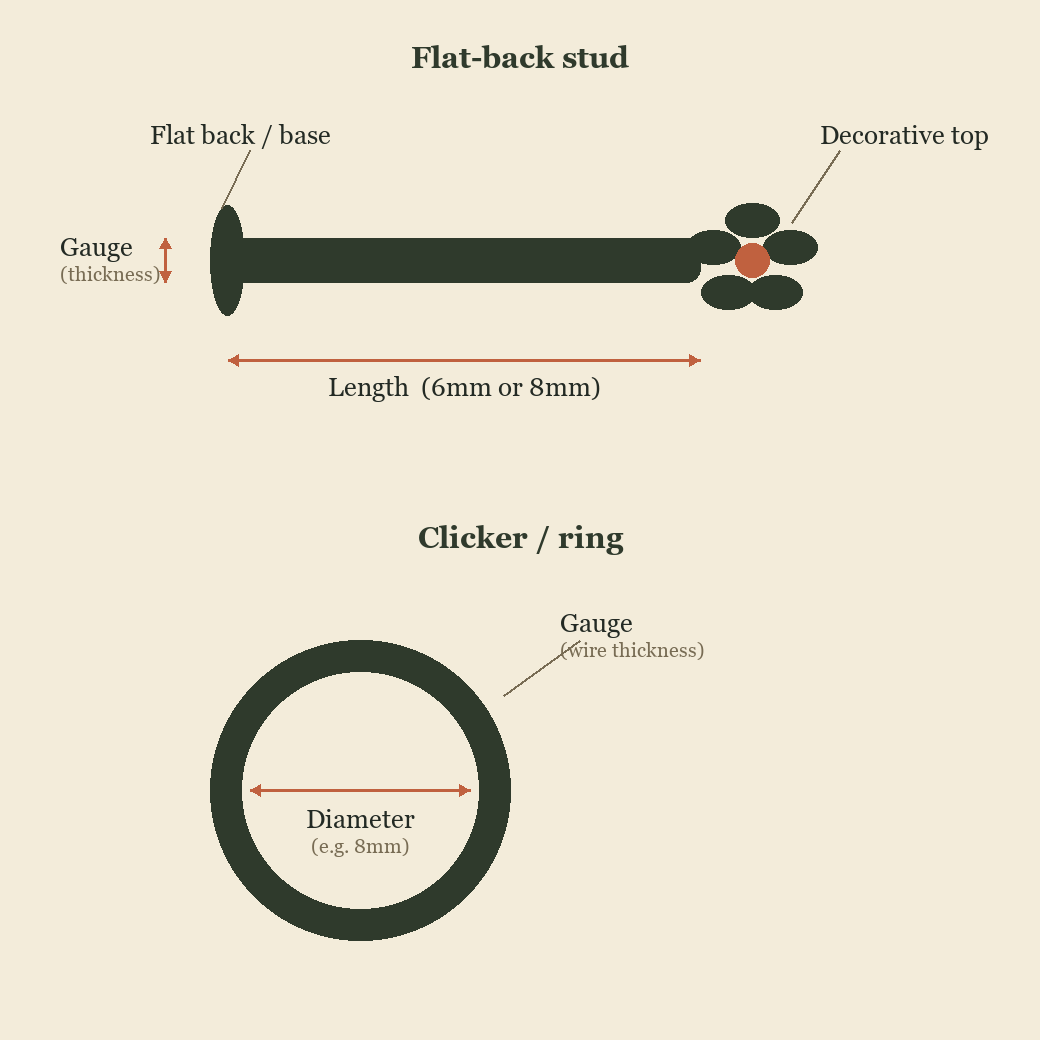
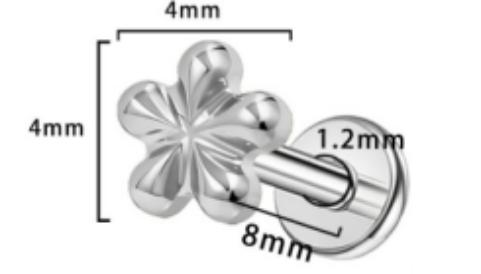
    A labelled diagram showing gauge, length, base and top on a flat back labret stud

    4. A low profile top

    The top is what your pillow actually touches, so height matters. A flat or slightly domed top presses evenly. A tall prong setting, a spike, a dangle or a large cluster concentrates the pressure into a point, and that point is sitting directly over a healing channel.

    Prong set stones are fine if they sit low, which good ones do. What to avoid at night is anything that stands proud of the ear, and anything with gaps that hair can thread through, because hair wrapping around a setting and pulling is a genuinely common cause of overnight irritation.

    5. Threadless, so it stays put

    Internally threaded pieces screw together, and a screw thread can slowly work loose against a pillow over the course of a night. Threadless pieces use a bent pin held by tension inside the post, which does not unscrew. It also means no thread dragging through the piercing channel when you change it.

    What to look for at night

    The safest choices for sleeping are plain titanium flat back labrets and low set single stone labrets, in 6mm for a healed piercing or 8mm while still swelling. Plain tops are the safest thing you can wear to bed, and single stone pieces are barely taller.

    If you want to sleep in gold, choose gold PVD over titanium rather than plated steel, so the metal touching your skin is still nickel free even where the finish has worn. If a piercing is still healing, though, I would wear plain titanium at night and save the gold for daytime.

    A silver zircon flat back labret stud in implant grade titanium by Willow and Thorn

    What not to sleep in

    • Hoops and clickers. They rotate, they catch on pillowcases and hair, and they lever on the piercing all night. Beautiful in the day, a bad idea at three in the morning.
    • Butterfly backs. For all the reasons above.
    • Anything dangly. It will wrap around something.
    • Screw back studs. They loosen, and the thread is rough on the channel.
    • Anything you cannot identify the metal of. Eight hours of contact is not the time to find out.
    • A long post you have never downsized. The most common fixable cause of a piercing that will not calm down.

    The pillow trick

    Jewellery solves most of it. The rest is about not lying directly on the piercing, and there is a very simple solution that piercers have recommended for years. Take a firm travel pillow, the U shaped kind, and sleep with your ear in the hole. Your head is supported, your ear touches nothing, and the piercing gets a full night without pressure. It looks slightly ridiculous and it works extremely well.

    A cheaper version is a folded towel with a gap, or a doughnut cushion. Either way the principle is the same: support the head, suspend the ear. If you have had a helix or a conch pierced and it will not settle, this alone often fixes it within a fortnight.

    It is also worth washing your pillowcase more often than usual while something is healing, and turning it over between washes. Hair product, sweat and skin oil all end up on that fabric, and then spend the night pressed against an open piercing.

    If you have already got a bump

    Do not take the jewellery out. Most bumps beside a healing piercing are irritation rather than infection, and they come from pressure, snagging or a post that is the wrong length. Removing the jewellery closes the channel over an inflamed area and makes everything harder.

    Instead, work through the causes. Downsize the post if the swelling has gone. Switch to a low profile top. Stop sleeping on it, using the pillow trick above. Clean it with sterile saline twice a day and otherwise leave it completely alone, with no tea tree oil, no alcohol and no picking. Most irritation bumps settle within a few weeks once the cause is removed. The aftercare guide has the full routine, and if it is hot, spreading, or you feel unwell, see a GP, because that is a different problem.

    The best earring to sleep in is one you cannot feel. Short post, flat back, low top, nickel free metal. That is the entire list.

    Frequently asked questions

    Can I sleep in hoops once I am healed?

    You can, and plenty of people do. It is still the most likely way to catch or bend a piece, so if you love a particular clicker, it is worth swapping to a stud at night. A fully healed lobe is fairly forgiving. Healed cartilage is less so.

    How long until I can sleep on a new piercing?

    For a lobe, usually six to eight weeks. For cartilage, expect several months, and often closer to a year for a helix. Let comfort be the guide rather than the calendar. If it is tender when you press it, it is not ready.

    Should I take my earrings out at night?

    Not while a piercing is healing, because the channel can shrink surprisingly fast and getting the jewellery back in will hurt and can damage it. Once fully healed, it is a personal preference, though most people find a comfortable flat back stud is easier to leave in than to keep track of.

    What length should I sleep in?

    6mm suits most healed lobes and helixes. Stay at 8mm while there is still swelling, and downsize as soon as it has gone. If you are unsure, ask your piercer to check the fit, or read the size guide.

    A plain silver segment clicker ring in implant grade titanium by Willow and Thorn

    Before you buy

    Whoever you buy from, look for a listing that names the metal standard (ASTM F-136 or ASTM F-67 titanium), states the gauge and length or diameter, and says plainly whether any gold colour is PVD or plating. If a seller cannot tell you, buy somewhere else. My guide to checking jewellery is genuinely nickel-free walks through what to look for, and the size guide covers the measurements.

    Trusted sources

    I only cite organisations that publish their own standards and research, so you can check anything here for yourself.

    Gemma

  • Titanium or surgical steel: which should you actually buy?

    Titanium or surgical steel: which should you actually buy?

    You are standing in front of two listings. One is a titanium flat back stud at around thirty dollars. The other is a surgical steel stud that looks almost identical for eight dollars. Both say they are safe. Both have good photos. The obvious question is whether the titanium one is genuinely worth nearly four times the price, or whether that is just what happens when a brand puts nicer photography on the same piece of metal.

    This is the honest version of that answer, written for Australian buyers. I don’t sell either metal, and I have tried to be straight about the cases where steel is perfectly fine and where the price difference genuinely does not buy you anything.

    If what you want is the underlying materials science rather than the buying decision, I have a separate and more technical piece on what is actually safe for a piercing. This guide is about which one to put in your basket.

    A gold flat back labret stud in implant grade titanium next to the standard used for surgical implants

    The short answer

    Buy titanium if the piercing is healing, if you have ever reacted to earrings, or if the piece will live in your ear more or less permanently. Steel is acceptable for a fully healed lobe, in a piece you wear occasionally, if you have never had a reaction in your life. In every other situation, the extra twenty dollars is the cheapest decision in the whole process.

    What you are actually paying for

    The price gap is not brand markup, or at least not mostly. Implant grade titanium costs more as a raw material than stainless steel, and it is meaningfully harder to machine, because it is tough, it work hardens and it eats tooling. A factory producing titanium pieces runs slower and replaces cutters more often. That is real cost, and it is why the gap exists across every seller, not just the expensive ones.

    What you get for it is a metal with no nickel in it. That is the entire proposition. Everything else, the lightness, the lack of tarnish, the comfort, is a bonus that falls out of the same choice.

    The comparison, plainly

    Implant grade titaniumSurgical steel
    StandardASTM F-136, a real published specificationNo single standard, usually 316L or 316LVM
    Nickel contentNone. Not an ingredient.Typically 8 to 12 percent
    Safe for healing piercingsYes, this is what piercers useNot recommended for fresh piercings
    WeightRoughly 45 percent lighter than steelNoticeably heavier in larger pieces
    TarnishDoes not tarnishCan discolour over time
    Typical price, single studA$28 to A$45A$6 to A$15
    Best forHealing piercings, sensitive ears, daily wearHealed lobes, occasional wear, no allergy history

    When steel is genuinely fine

    I am not going to pretend steel is dangerous, because for a lot of people it simply is not. If your lobes were pierced fifteen years ago, they have never given you a moment of trouble, and you want a cheap pair of studs for a specific outfit, steel will do the job and there is no reason to feel bad about it. Plenty of people wear steel their whole lives without a single reaction.

    The catch is that you cannot know in advance whether you are one of them, and the way you find out is by developing the allergy. Nickel sensitivity is not something you are born with. It builds through repeated exposure, and once it arrives it is permanent. So the real question is not whether steel will hurt you today. It is whether you want to keep rolling the dice.

    When steel is a bad idea

    • Any healing piercing. An open channel in constant contact with nickel is the textbook way to become sensitised. This is why professional piercers use titanium.
    • Cartilage, at any stage. Cartilage heals slowly and holds irritation for months. It is not the place to economise.
    • If you have ever reacted to a watch, a belt buckle, a zip or a pair of earrings. That is nickel telling you something.
    • Anything you will sleep in. Twenty four hour contact is the highest exposure scenario there is.
    • Children’s ears. A first piercing is exactly the moment a lifelong sensitivity gets created.
    A silver zircon segment clicker ring in implant grade titanium by Willow and Thorn

    The listings that are lying to you

    The genuinely difficult part of this decision is that a large number of Australian listings describe steel in language borrowed from titanium. You will see surgical steel described as hypoallergenic, which is a word with no legal definition. You will see titanium plated, which is steel with a thin coating that wears off. You will see G23 titanium, which is usually accurate and is the same thing as ASTM F-136, and you will see titanium alloy, which could be almost anything.

    The single test that cuts through all of it: ask the seller which standard the metal meets, and ask whether they hold a composition report. A composition report analyses what the alloy is actually made of. A nickel release test only measures what escapes the surface under specific conditions, which is a lower bar and is what most sellers have, if they have anything at all.

    A seller who has genuinely bought implant grade material can answer this in one email, and many will send a mill certificate or composition report if you ask. A seller who has bought from a marketplace and rebranded it usually cannot.

    What about the price gap on a whole ear?

    This is where people flinch, and it is worth doing the sums properly. Say you have six piercings and you want to fill all of them. In steel that might be sixty dollars. In titanium it is closer to two hundred. That is a real difference and it is not nothing.

    But titanium pieces do not need replacing. They do not tarnish, the finish does not lift, and the flat back means you are far less likely to lose one. Cheap studs get replaced, lost and thrown out, and most people who buy them buy them repeatedly. Over a few years the totals converge, and the titanium ear did not spend any of those years being itchy.

    There is also a middle path I would genuinely recommend if the budget is tight. Buy titanium for the piercings that matter, meaning anything healing, anything in cartilage and anything you sleep in. Wear whatever you like in a healed lobe for special occasions. You do not have to solve the whole ear at once.

    A note on gold

    The same logic applies with an extra wrinkle. Gold plated steel is the worst of both worlds, because you are paying for a finish that wears off and revealing nickel bearing steel underneath when it does. Gold PVD over titanium gives you the colour with nickel free metal beneath, so a worn spot exposes nothing but more titanium.

    An honest seller describes it as 18K gold PVD on titanium and says openly that it holds its colour for a few years of daily wear, not forever. Anyone promising a lifetime gold finish at this price is either using solid gold, which costs considerably more, or is guessing.

    A silver zircon threadless labret stud in implant grade titanium by Willow and Thorn

    So which should you actually buy?

    If I had to reduce it to a single sentence: buy the titanium unless the piercing is fully healed and you are certain you have no sensitivity, in which case buy whatever you like. The people who regret buying titanium are the ones who spent slightly more than they meant to. The people who regret buying steel are the ones who spent six months treating an irritated cartilage piercing that would have been fine.

    Titanium is not a luxury upgrade. It is the boring, correct choice that lets you stop thinking about your ears.

    Frequently asked questions

    Is 316L surgical steel nickel free?

    No. 316L stainless steel contains roughly ten to fourteen percent nickel. It is described as low release rather than nickel free, meaning most of the nickel stays locked in the alloy under normal conditions. In a healing piercing those conditions do not apply.

    Is G23 titanium the same as implant grade?

    Yes. Grade 23, G23, Ti-6Al-4V ELI and ASTM F-136 all describe the same alloy. Grade 5 titanium is a related but less refined version and is not the implant standard, so it is worth checking which one is meant.

    Will titanium set off airport scanners?

    No. Body jewellery is far too small, and titanium is not especially magnetic. This comes up a lot and it is not something to worry about.

    Can I mix titanium and steel in the same ear?

    Physically, yes, nothing bad happens between the two. Practically, if one piercing is reacting and the others are not, the metal in the reacting one is the first thing to change.

    How do I know what size to order?

    Gauge and length both matter and they are easy to get wrong. The size guide shows exactly what is being measured, and my guide to ear piercing placements covers what suits each spot.

    Before you buy

    Whoever you buy from, look for a listing that names the metal standard (ASTM F-136 or ASTM F-67 titanium), states the gauge and length or diameter, and says plainly whether any gold colour is PVD or plating. If a seller cannot tell you, buy somewhere else. My guide to checking jewellery is genuinely nickel-free walks through what to look for, and the size guide covers the measurements.

    Trusted sources

    I only cite organisations that publish their own standards and research, so you can check anything here for yourself.

    Gemma

  • Best nickel free earrings for sensitive ears in Australia

    Best nickel free earrings for sensitive ears in Australia

    If your ears go red, itchy or sore every time you wear earrings, you are not unlucky and you are not doing anything wrong. You almost certainly have a nickel sensitivity, and you share it with a very large number of Australians. The good news is that it is completely solvable. The bad news is that the word hypoallergenic, which is plastered across half the earrings sold in this country, means almost nothing.

    This guide explains what actually causes the reaction, what to look for when you buy, and which pieces are genuinely safe for sensitive ears. It is written for Australian shoppers, in Australian dollars, by someone who has spent a lot of money learning this the expensive way.

    A silver zircon flat back labret stud in nickel free implant grade titanium by Willow and Thorn

    The short answer

    Buy implant grade titanium, specified as ASTM F-136. That is the whole answer. It contains no nickel at all, which means there is nothing there to react to. Not surgical steel, not sterling silver, not gold plated brass, not anything described only as hypoallergenic or nickel safe. If a seller cannot name the standard their metal meets, assume it does not meet one.

    If you want to understand why, and how to spot the marketing language that gets used instead of facts, keep reading.

    What is actually happening to your ears

    Nickel allergy is a delayed contact allergy. Your immune system has decided that nickel is a threat, and every time nickel touches your skin for long enough, it mounts a response. That response is the redness, the itch, the weeping and sometimes the little crusted patch behind the earring. It usually shows up hours after you put the earrings in rather than immediately, which is why so many people never connect the two.

    It is one of the most common contact allergies in the world, and it affects women considerably more often than men, largely because of earrings. It is also something you develop rather than something you are born with. Repeated exposure is what sensitises you, and once you are sensitised, you stay that way for life. That is worth sitting with for a moment, because it changes how you think about cheap earrings: they are not just uncomfortable, they are how the problem gets created.

    Piercings make all of this worse. Ordinary skin has a barrier. A piercing channel does not, or at least not a fully formed one, so the metal is in direct contact with living tissue for twenty four hours a day. That is the ideal set of conditions for both provoking a reaction and creating a new sensitivity.

    The words that mean nothing

    Australian jewellery listings are full of reassuring language that carries no legal weight whatsoever. It is worth learning to read past it.

    • Hypoallergenic. Not a regulated term. Anyone can print it on anything. It expresses a hope, not a specification.
    • Surgical steel. Sounds medical, is not a single defined thing, and every variety of it contains nickel.
    • Surgical grade. A step vaguer again. There is no such grade.
    • Nickel free. Sometimes true and sometimes means the nickel is below a release threshold rather than actually absent.
    • Titanium plated or titanium coated. A thin surface layer over something else entirely. When it wears, you meet whatever is underneath.
    • Sterling silver. Nickel free in principle, but tarnishes, and the alloy varies by maker.

    The phrase that does mean something is ASTM F-136. That is a real, published, testable standard for implant grade titanium alloy, and it specifies exactly what the metal is made of. If a seller names it, you can ask for the test report. If they cannot produce one, you have learned something useful.

    Why implant grade titanium is different

    Implant grade titanium is the alloy used to make surgical implants that live inside the human body for decades. It is titanium with roughly six percent aluminium and four percent vanadium, refined to remove impurities, and there is no nickel in the recipe at all. Not a small amount, not a locked in amount. None.

    That is what makes it the right answer for sensitive ears. Every other approach is about keeping the nickel from getting out. Titanium removes the nickel from the equation entirely, so there is no threshold to worry about, nothing to leach as the piece ages, and nothing that becomes a problem if the plating wears through. It is also light, which people notice immediately, and it does not tarnish.

    I have written a longer piece comparing titanium, surgical steel and sterling silver if you want the full breakdown of each.

    A silver zircon flat back labret stud in implant grade titanium, safe for sensitive ears

    What about gold?

    Gold is where most people get caught out, because gold itself is not the problem. Pure gold is inert and perfectly safe. The problem is that pure gold is far too soft for jewellery, so it is always alloyed with something, and in cheaper gold jewellery that something very often includes nickel. Gold plated pieces are worse again, because the plating is a thin skin over a base metal, and that base metal is usually brass or nickel alloy. When the plating wears, which it always does eventually, you are wearing the base metal directly.

    There are two safe ways to wear gold with sensitive ears. Solid gold, at 14K or 18K, from a maker who will tell you what the alloy contains. Or gold PVD over implant grade titanium. PVD is a vacuum process that bonds a hard, thin layer of gold coloured material to the surface, and because the piece underneath is nickel free titanium, even a worn spot exposes nothing but more titanium.

    An honest seller describes it as 18K gold PVD on titanium and tells you it stays colourfast for a few years of normal wear, rather than claiming it lasts forever. If a listing promises forever, be wary.

    What to buy for sensitive ears

    For everyday lobes

    A flat back titanium labret stud is the most comfortable thing you can put in a lobe, and it is a revelation if you have spent years with butterfly backs. There is no clasp to press into the back of your ear, nothing to fall off in bed, and nothing to lose down the drain. Choose 18 gauge for most lobes, 16 gauge if you were pierced thicker, and a length of 6mm to 8mm depending on your ear.

    For cartilage

    The same flat back labret in 16 gauge is the standard, and it is what piercers use. Cartilage is fussier and slower to heal than a lobe, so the nickel question matters even more here. If you are shopping for a healing helix specifically, I have a dedicated guide to that.

    For hoops

    Segment clickers are the nicest option, because they are a single piece of titanium that hinges open and clicks shut, with no join to catch and no separate ball to lose. An 8mm or 10mm ring suits most lobe and healed helix placements.

    A silver zircon segment clicker ring in nickel free implant grade titanium by Willow and Thorn

    How to know a seller is telling the truth

    Four questions will separate a serious seller from a reseller who has copied a listing. Ask them by email and see what comes back.

    • Which standard does your titanium meet? The answer you want is ASTM F-136, sometimes also written as Grade 23 or Ti-6Al-4V ELI.
    • Do you hold a composition test report on the metal itself? This is different to a nickel release test. Composition tells you what the alloy is made of. Release testing only measures what escapes the surface.
    • Is the gold plated or solid, and what is underneath it? A straight answer here tells you a lot.
    • Are the posts and the tops the same material? Some sellers use good metal for the visible part and something cheaper for the post that actually sits in your piercing.

    A good seller will answer all four without hesitation. If they dodge any of them, take that as your answer.

    If you are already reacting

    Take the offending earrings out. Do not push through it, because every additional exposure deepens the sensitisation. Clean the area gently with sterile saline and let it settle. If the skin is broken, weeping or spreading, see a GP or a pharmacist, as a genuinely infected piercing is a different problem to an allergic one and needs different treatment.

    Once things have calmed down, switch to implant grade titanium and give it a few weeks. Most people find the difference is immediate and slightly annoying, in the sense that they realise they could have solved this years ago. If reactions continue even in titanium, it is worth asking your GP about patch testing, because there are other contact allergies and it is useful to know which one you have.

    Sensitive ears are not a personality trait. They are usually just a nickel problem wearing a disguise.

    Frequently asked questions

    Is titanium really nickel free, or just low nickel?

    Genuinely nickel free. ASTM F-136 titanium is an alloy of titanium, aluminium and vanadium, with strict limits on iron, oxygen, nitrogen, carbon and hydrogen. Nickel is not an ingredient. This is why it is used for implants that stay in the body permanently.

    Can I wear titanium if I react to everything?

    Almost certainly, yes. Titanium is one of the least reactive metals there is, which is exactly why it is used surgically. True titanium allergy exists but it is genuinely rare.

    Is sterling silver safe for sensitive ears?

    Usually, but not always, and it is a poor choice for anything healing. Sterling is 92.5 percent silver and 7.5 percent something else, most often copper, but the alloy is not standardised the way implant titanium is. It also tarnishes, and tarnish sitting in a piercing is not something you want.

    Why is titanium jewellery more expensive?

    Because the metal costs more and it is harder to machine. In practice the difference on a single stud is a few dollars. Set against years of sore ears, it is not really a cost.

    Before you buy

    Whoever you buy from, look for a listing that names the metal standard (ASTM F-136 or ASTM F-67 titanium), states the gauge and length or diameter, and says plainly whether any gold colour is PVD or plating. If a seller cannot tell you, buy somewhere else. My guide to checking jewellery is genuinely nickel-free walks through what to look for, and the size guide covers the measurements.

    Trusted sources

    I only cite organisations that publish their own standards and research, so you can check anything here for yourself.

    Gemma

  • Best jewellery for a fresh helix piercing in Australia

    Best jewellery for a fresh helix piercing in Australia

    A helix piercing is one of the easiest piercings to fall in love with and one of the easiest to get wrong. It sits in the upper curve of the ear, through cartilage rather than soft lobe tissue, and cartilage is fussy. It heals slowly, it holds a grudge, and it reacts to things a lobe would shrug off. The jewellery you put in it in those first months matters more than almost anything else you do.

    This guide is about what to actually buy for a fresh helix, and why. Not the prettiest piece in the shop, but the piece that gives your ear the best chance of healing cleanly so that you can wear the pretty one later. I have written it for Australian buyers, with Australian shipping and Australian prices in mind, because a lot of the advice online assumes you can walk into a studio in Los Angeles.

    A silver zircon flat back labret stud in implant grade titanium, suitable for a healing helix piercing

    The short answer

    If you want the summary before the detail, here it is. For a fresh or recently pierced helix, buy an implant grade titanium flat back labret, 16 gauge, in a length of 8mm for the initial healing period, with a modest flat top rather than a large or dangly one. Avoid rings, avoid surgical steel, avoid anything gold plated in the first few months, and avoid anything with a butterfly back.

    Everything below explains why each of those choices matters, and what to do once the piercing has settled. If you are already healed and just shopping for something beautiful, skip ahead to the section on what to wear once you are healed.

    Why cartilage is different to a lobe

    A lobe is soft, fleshy tissue with a generous blood supply. That blood supply is what does the healing, and it is why lobes usually settle within six to eight weeks. Cartilage has almost no direct blood supply of its own. It is fed by the thin layer of tissue that surrounds it, which means everything happens more slowly. A helix commonly takes six to twelve months to fully heal, and some take longer.

    The practical consequence is that a helix stays vulnerable for a long time. Every knock, snag and pressure point during those months has the potential to irritate it, and irritated cartilage responds by swelling, weeping or forming a bump. Your jewellery is the one variable you control every hour of every day, so it is worth getting right.

    What to look for, and why

    1. Implant grade titanium, not surgical steel

    This is the single most important choice. Implant grade titanium, properly specified as ASTM F-136, is titanium alloyed with aluminium and vanadium and refined to the standard used for surgical implants. It contains no nickel. Surgical steel, by contrast, always contains nickel, usually somewhere between eight and twelve percent, and while good quality steel holds most of that nickel locked in the alloy, a healing piercing is exactly the situation where a little leaching matters.

    Nickel allergy is common, it affects women more often than men, and it can develop over time rather than being something you are born with. A fresh piercing is an open wound sitting in constant contact with metal, which is one of the classic ways people become sensitised in the first place. Choosing titanium removes the question entirely. If you want the longer comparison, I have written a full breakdown of titanium versus surgical steel versus sterling silver.

    A word on what to look for when you buy. The phrase you want on the listing is implant grade titanium or ASTM F-136, ideally both. Terms like surgical grade, hypoallergenic and titanium coated are not the same thing and are not regulated. If a seller cannot tell you which standard their metal meets, treat that as your answer.

    2. A flat back labret, not a ring

    Rings look wonderful in a healed helix and they are a genuinely bad idea in a fresh one. A ring moves. It rotates with every turn of your head, it swings when you walk, and every bit of that movement drags across the healing channel inside your ear. It also sits away from the ear, which makes it far easier to catch on a jumper, a towel, a hairbrush or a pillow.

    A flat back labret is the opposite. A straight post goes through the piercing, a flat disc sits flush behind the ear, and a decorative top sits on the front. There is nothing to swing, nothing curving behind the ear and nothing sticking out to catch. The flat disc is smooth against the skin, so there is no clasp to press in when you sleep. If you want the detail on how they work, my guide to flat back labrets covers it properly.

    A silver flat back labret stud in implant grade titanium by Willow and Thorn

    3. Threadless, so nothing loosens

    Flat back labrets come in two mechanisms. Internally threaded pieces screw together. Threadless pieces, sometimes called push pin, use a slightly bent pin on the top that grips inside a hollow post by tension. Threadless is the gentler of the two for a healing piercing, because there is no thread to catch on the inside of the channel as it passes through, and nothing that can gradually unscrew itself while you sleep.

    Threadless also makes changing your top far easier once you are healed, which matters more than you might think. If changing a piece is fiddly and stressful, you will handle your ear more, and handling is the enemy. It is the main reason to choose threadless.

    4. The right gauge and the right length

    Gauge is the thickness of the post, and it runs backwards, so a smaller number means a thicker bar. For a helix, 16 gauge, which is 1.2mm, is the standard in Australia and the thickness most piercers use. Some studios pierce cartilage at 18 gauge, which is 1.0mm. If you are buying a replacement, match what you were pierced with rather than guessing, because putting a thinner post into a channel made for a thicker one lets the piercing shrink, and forcing a thicker post into a thinner channel is a genuinely bad experience.

    Length matters just as much and is the thing people most often get wrong. A fresh piercing swells, so it is pierced with a deliberately long post, usually 8mm, to leave room. Once the swelling has gone down, that extra length becomes a liability, because a long post moves around and levers on the piercing every time it is knocked. Most healed helixes are comfortable at 6mm. The size guide walks through measuring properly.

    5. A top that does not fight you

    For the healing months, choose a top that is flat, smooth and not much wider than the post. A small prong set stone, a plain ball or a low profile shape are all excellent. What you want to avoid is anything large, anything with dangling parts, and anything with an intricate open setting that hair can thread itself through. There will be plenty of time for the dramatic piece later, and it will look better in an ear that healed cleanly.

    What to actually put in a fresh helix

    For a healing helix, the pieces to reach for are plain titanium flat back labrets or small single stone labrets, in 16 gauge, 8mm to start and 6mm once the swelling settles. Unplated, low profile and completely nickel free is exactly the boring, reliable combination cartilage wants.

    Hold off on gold for the first few months. Gold PVD over titanium is a hard, durable finish and a genuinely good one, but any finish is a surface layer, and the safest thing for an open wound is bare implant grade metal with nothing on it at all. Once the piercing is settled, gold is completely fine.

    What to wear once you are healed

    This is the fun part, and it is worth waiting for. A healed helix opens up everything. Segment clickers and hoops finally become an option, and a hoop through a healed helix is one of the best looking piercings there is. Larger and more decorative tops become safe, gold becomes safe, and you can start thinking about how the helix sits alongside your other piercings rather than just protecting it.

    How do you know you are healed? Not by the calendar. A healed piercing is one that has been completely calm for months, with no crusting, no tenderness when you touch it, no swelling and no reaction when you sleep on it. If it still flares up occasionally, it is still healing, whatever month it is. If you are planning how the helix will work with the rest of your ear, my guide to ear piercing placements is a good place to start.

    A curated ear featuring several titanium studs and hoops including a helix piercing

    The most common mistakes

    • Buying a ring too early. The most common cause of an unhappy helix. Wait until it is fully settled.
    • Trusting the word hypoallergenic. It is a marketing word with no legal definition in Australia. Ask for the standard instead.
    • Leaving the long post in. The extra length is for swelling. Once the swelling has gone, downsize.
    • Sleeping on it. Pressure for eight hours a night is the single biggest cause of helix bumps. A travel pillow with the hole under your ear works beautifully.
    • Twisting the jewellery. Old advice, and it was always wrong. Turning the jewellery tears the healing tissue every single time.
    • Changing it too soon. Every early change resets some of the progress. If you must change it, have your piercer do it.

    Aftercare, briefly

    Good jewellery does most of the work, but not all of it. Clean the piercing twice a day with sterile saline, let it dry, and otherwise leave it alone. No alcohol, no tea tree oil, no hydrogen peroxide, no antibacterial ointments. Do not turn it, do not pick at the crusting, and wash your hands before you touch it at all. The full aftercare guide goes through it step by step.

    If a bump appears, do not panic and do not take the jewellery out. Most helix bumps are irritation, not infection, and they come from pressure, snagging or a piece that is the wrong size. Fix the cause and the bump usually settles on its own.

    Buying in Australia

    A practical note on shopping locally. Ordering piercing jewellery from overseas marketplaces is cheap and it is a gamble, because you have no way of verifying what the metal actually is, and the listings that say titanium most loudly are often the ones least able to prove it. Buying from an Australian seller also means your piece arrives in days rather than weeks, which matters when you have a downsize appointment coming up.

    Whoever you buy from, ask for the material standard and, ideally, a certificate. A seller of genuine implant grade titanium will be happy to show you.

    The best jewellery for a fresh helix is the piece you stop thinking about. Smooth, light, correctly sized, and completely uninteresting to your ear.

    Frequently asked questions

    Can I put a hoop in a new helix?

    You can, and I would strongly suggest you do not. A hoop moves constantly and catches easily, and in cartilage that movement is what turns a healthy piercing into an irritated one. Give it six to twelve months of calm, then enjoy the hoop.

    Is titanium worth the extra cost over steel?

    Yes, and the gap is smaller than people expect. The difference between a titanium piece and a steel one is a few dollars, and the difference in outcome can be a piercing that heals versus one that fights you for a year. It is the cheapest insurance in the whole process.

    What size should I order?

    16 gauge is standard for a helix in Australia. Order 8mm if you are still in the first few weeks and swelling, and 6mm once things have settled. If you are unsure, the size guide shows you exactly what is being measured.

    How do I know my jewellery is genuinely nickel free?

    Look for ASTM F-136 named explicitly, and ask the seller whether they hold a composition test report on the metal itself rather than just a surface release test. The two are different things, and the composition report is the meaningful one.

    A gold zircon flat back labret stud in implant grade titanium, suitable for a healed helix piercing

    Before you buy

    Whoever you buy from, look for a listing that names the metal standard (ASTM F-136 or ASTM F-67 titanium), states the gauge and length or diameter, and says plainly whether any gold colour is PVD or plating. If a seller cannot tell you, buy somewhere else. My guide to checking jewellery is genuinely nickel-free walks through what to look for, and the size guide covers the measurements.

    Trusted sources

    I only cite organisations that publish their own standards and research, so you can check anything here for yourself.

    Gemma