

The daith is the small fold of cartilage that curves over the entrance to your ear canal. A ring through it sits in a way no other piercing does, tucked inside the ear rather than around its edge, which is why it has become one of the most requested piercings in Australia. It is also one of the trickiest to buy jewellery for, because the shape of the fold does most of the deciding.
This guide covers what to wear in a daith, how to work out what diameter you need, and the honest answer to the migraine question. Australian buyers, Australian dollars.
The short answer
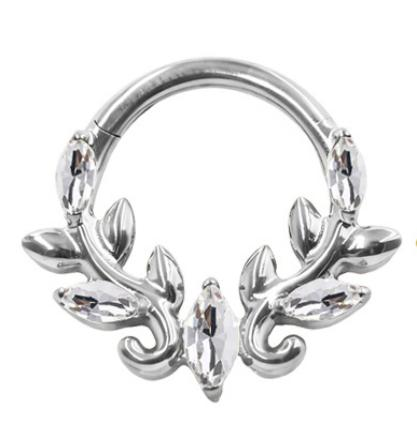
A daith is one of the few piercings usually done with a ring from the start, because a straight bar does not sit well in a curved fold. Buy an implant grade titanium clicker in 16 gauge, in a diameter that matches your anatomy, most commonly 8mm. Have your piercer size it rather than guessing, because a daith ring that is slightly wrong is uncomfortable in a way that is hard to ignore.
Why the daith is different
Most cartilage piercings are best started with a flat back labret so that nothing moves. The daith is the exception. It passes through a curved fold, and a straight post through a curve either presses at both ends or sits at an angle, neither of which is comfortable. A curved piece that follows the fold is the better fit, which is why most piercers use a ring or a curved barbell from day one.
That does mean a daith has a ring in it while healing, which brings all the usual ring problems: movement, catching, and pressure. It is one reason daiths can be slow, often taking six to twelve months. It is also why getting the diameter right matters so much.
Getting the diameter right
This is the whole game with a daith. Too small and the ring presses against the fold, restricts blood flow and traps discharge where you cannot clean it. Too large and it hangs loose, swings when you move, and catches on everything.
Most daiths take an 8mm ring. Some anatomy needs 10mm, and smaller ears sometimes take 6mm. There is no way to work this out reliably from a photo of someone else’s ear, because the fold varies enormously between people. If you were pierced professionally, ask what diameter you are wearing and write it down, because it is the number you will need every time you buy.
Gauge is more consistent: 16 gauge, which is 1.2mm, is standard in Australia. My guide to gauges explains the numbering if it is unfamiliar.
Clicker or captive bead?
A captive bead ring is the older style, a horseshoe of metal holding a ball by tension. They work, they are cheap, and they are genuinely awful to change, because the ball pings across the room at the worst moment. In a daith, which is tucked inside the ear and hard to see, this is worse again.
A segment clicker is a single piece of titanium with a hinged section that clicks shut. Nothing to drop, nothing to lose, no gap where the join is, and it can be done one-handed. For a daith specifically, where you are working in an awkward spot largely by feel, this is a meaningful difference.
The metal question
A daith heals slowly and sits in a fold that traps moisture, sweat and hair product. That combination, months of contact in a warm damp spot, is about the most demanding thing you can ask of a metal. Implant grade titanium, ASTM F-136, contains no nickel, does not corrode and does not tarnish, which is why it is the standard for this.
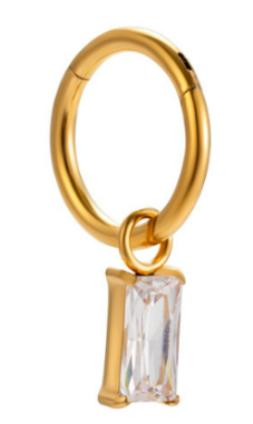
Avoid gold plated pieces while healing. Plating is a surface layer, and a daith is exactly the environment where a surface layer gets tested. Gold PVD over titanium is the better option, since a worn spot exposes only more titanium, but for a fresh daith I would still wear plain titanium and save the gold for later.
The migraine question, honestly
You will have seen the claim that a daith piercing relieves migraines. It is the reason a lot of people book one, so it deserves a straight answer rather than either a sales pitch or a dismissal.
The theory borrows from acupuncture, on the idea that the daith sits near a pressure point associated with headache relief. The evidence is genuinely weak. What exists is mostly case reports and surveys rather than controlled trials, and the studies that have looked at it carefully tend to attribute the improvement people report to the placebo effect, which is powerful and well documented for pain conditions.
So my position is this: get a daith because you like how it looks, which is an excellent reason. If your migraines improve, that is a lovely bonus. Please do not stop any treatment your doctor has prescribed on the strength of a piercing, and if you get migraines regularly, that is a conversation for your GP rather than a piercing studio.
Buy a daith for the way it looks. Anything else it does for you is a bonus, not a plan.
Healing a daith
Sterile saline twice a day, then leave it completely alone. The daith is tucked inside the ear, so rinsing thoroughly matters more here than elsewhere, because discharge and product can collect in the fold where you cannot see it. Let the water from the shower run through the ear and dry it gently afterwards.
The two things most likely to irritate a daith are sleeping on that side and earphones. In-ear buds sit directly against a healing daith, so switch to over-ear headphones while it settles, which is the opposite of the advice for a conch. If you have both piercings healing at once, you have my sympathy and you should probably use speakers.
The full aftercare guide covers the routine, and if a bump appears, my guide to piercing bumps explains what is usually causing it. Do not remove the jewellery at the first sign of trouble.
Frequently asked questions
Does a daith piercing hurt?
More than a lobe, comparable to other cartilage piercings, and over quickly. The fold is thick, so there is a firm pressure rather than a sharp sting. Most people describe the pinch as brief and the ache afterwards as the harder part.
What size ring for a daith?
8mm suits most people, with 6mm and 10mm covering the rest. Ask your piercer for your diameter rather than guessing, because a daith ring that is even a millimetre out is noticeably uncomfortable.
Can I wear a curved barbell instead?
Yes, and some piercers prefer them for healing because they sit snugly and have less to catch on. A ring is the classic look, a curved barbell is the practical one. Both are fine in implant grade titanium.
How long until I can change it?
Six to twelve months, and only once it has been completely calm for a stretch. Because a daith is awkward to reach, it is worth having your piercer do the first change rather than fighting with it in front of a mirror.
What daith jewellery costs in Australia
A titanium clicker from a seller who can name their standard generally runs A$40 to A$60. Clickers cost more than studs because the hinge and the seamless closure are machined into one continuous ring, which is a genuinely harder piece to make well. A poorly made clicker shows it immediately: the closure sits proud, you can feel the join with a fingernail, and it catches on hair.
The cheap end, ten to twenty dollars, is steel or unspecified alloy. That is a bad trade in a daith specifically, because this is a slow healing piercing in a warm damp fold, which is the hardest test you can give a metal.
Buy at least two once you are healed. A daith is awkward to reach and fiddly to change, so most people settle on one piece they wear more or less permanently. Having a spare means a lost or damaged ring is not a crisis.
Styling a daith
A daith sits inside the ear rather than on its edge, which makes it one of the few piercings that reads as subtle and dramatic at once. From straight on it is barely visible. In profile it frames the ear canal and becomes the focal point of the whole ear.
Because it sits low and inward, a daith rarely competes with anything else, so it layers happily with a full helix or a stacked lobe. The one pairing to think about is a daith and a conch together, since both are rings in the middle of the ear and two rings that close to each other can read as busy. If you want both, a smaller daith ring with a conch stud usually balances better. My guide to ear piercing placements covers how the two sit together.
A note on getting it pierced
Not every ear can take a daith. The fold needs enough depth for the needle to pass cleanly and enough room for a ring to sit without pressing, and some ears simply do not have it. A piercer will tell you in a moment by looking, and a good one will say no rather than force it. If you are told your anatomy does not suit a daith, that is a piercer doing their job properly.
It is also a piercing worth paying a professional for. The daith is done at an angle, in a confined space, with the needle passing close to the ear canal, so it is not a placement to get done at a shopping centre kiosk with a gun. Guns cannot be sterilised properly and cannot pierce cartilage cleanly in any case.
Before you buy
Whoever you buy from, look for a listing that names the metal standard (ASTM F-136 or ASTM F-67 titanium), states the gauge and length or diameter, and says plainly whether any gold colour is PVD or plating. If a seller cannot tell you, buy somewhere else. My guide to checking jewellery is genuinely nickel-free walks through what to look for, and the size guide covers the measurements.
Trusted sources
I only cite organisations that publish their own standards and research, so you can check anything here for yourself.
- Association of Professional Piercers: jewellery for initial piercings
- Association of Professional Piercers: aftercare guidelines
- DermNet: nickel allergy
Gemma
Leave a Reply