

Gold jewellery is sold in Australia under at least five different descriptions, most of which are designed to sound like solid gold without being it. Gold plated, gold filled, gold vermeil, PVD gold, solid gold. They are wildly different products at wildly different prices, they wear in completely different ways, and only some of them are safe to put in a piercing.
This guide explains what each one actually is, how long it lasts, and which to buy. I don’t sell jewellery, so this is the straight version of what each finish will and will not do, including gold PVD over titanium.
The short answer
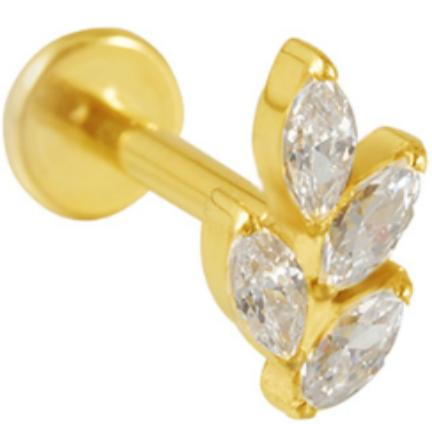
For a piercing, buy either solid gold at 14K or 18K, or gold PVD over implant grade titanium. Avoid gold plated and gold vermeil in anything that goes through your skin, and treat gold filled as acceptable for earrings that sit on the outside but not for a healing piercing. The thing that matters is not the gold. It is what is underneath it.
The five kinds of gold, plainly
Solid gold
Gold all the way through, alloyed with other metals for hardness. 14K is 58 percent gold, 18K is 75 percent. It never wears off, because there is no coating to wear. It is also the most expensive by a long way, and it is heavy, which some people love and some notice by the end of the day.
The catch is the alloy. Pure gold is far too soft, so it is always mixed with something, and in cheaper gold that something can include nickel. White gold in particular is often alloyed with nickel to achieve the colour. If you are buying solid gold and you have sensitive ears, ask what the alloy contains. A good jeweller will tell you.
Gold filled
A thick layer of gold mechanically bonded to a base metal core, legally required to be at least five percent gold by weight. It is far more substantial than plating and can last years on an item worn outside the skin. It is a genuinely decent product for earrings, chains and bracelets.
It is still a layer over a base metal, though, and the base is usually brass. For a piercing that sits in an open channel, I would not use it.
Gold vermeil
Gold plating over sterling silver, with a minimum thickness required to use the name. Better than ordinary plating because the base is silver rather than brass, so there is no nickel underneath. But the plating is still thin, silver tarnishes once exposed, and vermeil does not cope well with moisture. Fine for occasional wear, poor for a piercing you sleep in.
Gold plated
A microscopically thin layer of gold deposited on a base metal, often measured in fractions of a micron. This is what most cheap gold coloured jewellery is. It wears through quickly, sometimes in weeks, and what is underneath is usually brass or a nickel bearing alloy. In a piercing this is the worst option available, because the moment the plating wears you have nickel sitting in an open wound.
Gold PVD
Physical vapour deposition. The piece goes into a vacuum chamber and a gold coloured material is vaporised and bonded to the surface at a molecular level. The result is far harder and far more scratch resistant than electroplating, and it does not flake. It is the same process used on high end watch cases and surgical tools.
PVD is still a surface finish rather than solid gold, so it will eventually wear at high friction points. The reason it works for piercing jewellery is what sits underneath. When PVD is applied over implant grade titanium, a worn patch exposes more titanium, which is nickel free and completely safe. When it is applied over steel, a worn patch exposes nickel.
How long gold PVD over titanium lasts
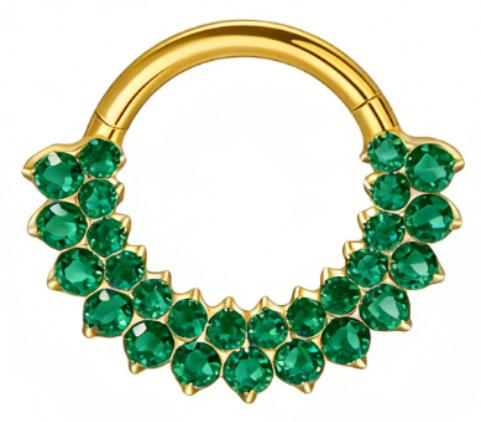
The most honest way to describe this finish is the long way: 18K gold PVD over ASTM F-136 implant grade titanium. Good sellers describe it exactly like that, rather than just calling it gold, because the difference matters.
Expect it to keep its colour for a few years of normal daily wear rather than forever. Anyone selling a plated finish at this price point and promising it lasts a lifetime is either using solid gold or guessing. PVD is hard, but it is not permanent, and how long yours lasts depends on where the piece sits and how much friction it gets.
What you can count on is that when it does eventually wear, nothing harmful is exposed, because the base is titanium rather than steel. That is the whole point of choosing titanium underneath.
How to make gold last longer
- Take it off for the pool and the ocean. Chlorine and salt are hard on any finish.
- Put jewellery on last. Perfume, hairspray, sunscreen and fake tan all attack plating and PVD.
- Do not scrub it. Warm water, a drop of mild soap and a soft cloth. No polishing cloths, which are abrasive and designed to remove a surface layer.
- Avoid ultrasonic cleaners. They are fine for solid metal and unkind to finishes.
- Rotate your pieces. The piece you wear every single day wears fastest. A small collection lasts longer than one favourite.
- Wear the unplated titanium while healing. Bare metal is the safest thing for an open piercing, and it saves the gold from the roughest months.
Is gold worth it for a piercing?
If you mean solid gold, it is worth it when you want something permanent and you have the budget, and it is the only option that genuinely never changes. Expect to pay several times what titanium costs for the same shape.
If you mean PVD gold over titanium, yes, with clear eyes. You are buying the colour and the look, on a piece whose safety does not depend on the finish surviving. You will probably want to replace it in a few years, which is worth factoring in. Many people buy titanium in silver tone for the pieces they never take out, and gold for the visible statement pieces they change more often. That is a sensible way to split a budget.
What is never worth it for a piercing is gold plating over an unspecified base metal, no matter how good the photo looks or how low the price is.
Frequently asked questions
Will PVD gold turn my ear green?
No. Green staining comes from copper in cheap alloys reacting with skin. There is no copper in implant grade titanium and none in the PVD layer.
Can I wear gold in a healing piercing?
I would not. Bare implant grade titanium is the safest thing for an open wound, and healing is the period of heaviest wear on any finish. Wear titanium for the first few months and switch to gold once it has settled.
Is 18K PVD the same as 18K gold?
No, and it is worth being clear about. 18K describes the colour and tone of the finish, not the composition of the whole piece. The piece is titanium with a gold coloured surface. Anyone implying otherwise is being slippery.
Does PVD wear evenly?
Mostly, but high friction points go first. On a labret that tends to be the edge of the disc where it sits against the skin, which is the part nobody sees. Visible tops usually keep their colour longest.
Can I mix gold and silver tone pieces?
Absolutely, and it looks intentional when it is done with a bit of structure. My guide to mixing gold and silver covers how to keep a two-tone ear looking deliberate.
How to read a gold listing in Australia
Most of the confusion in this category is deliberate, so it helps to know the tells. A listing that says gold tone, gold colour or gold finish is telling you there is no meaningful gold content at all. A listing that says 18K without the words solid or PVD is usually describing the colour of a coating rather than the composition of the piece. Anything that says gold over stainless steel is telling you the base is nickel bearing, whether or not it puts it that way.
What an honest listing looks like is specific and slightly less exciting. It names the base metal and its standard, it names the finish and the process, and it does not promise permanence. A good one reads something like 18K gold PVD on ASTM F-136 implant grade titanium, which is a mouthful and is exactly the point.
One more test worth applying: if the seller quotes a plating thickness in microns, they probably know what they are selling. If they cannot answer what is underneath the gold, that is your answer.
A word on white gold
White gold deserves its own warning if you have sensitive ears. Gold is naturally yellow, so white gold is made by alloying it with a white metal, and historically that metal has very often been nickel. It is then usually rhodium plated on top to get the bright white finish, and when that rhodium wears, which it does, you meet the alloy underneath.
This catches people out because white gold feels like a premium purchase, and premium is not the same as nickel free. If you want a silver tone in a piercing and you react to things, implant grade titanium is the straightforward answer. Palladium white gold exists and is nickel free, but you have to ask, and it costs considerably more.
Before you buy
Whoever you buy from, look for a listing that names the metal standard (ASTM F-136 or ASTM F-67 titanium), states the gauge and length or diameter, and says plainly whether any gold colour is PVD or plating. If a seller cannot tell you, buy somewhere else. My guide to checking jewellery is genuinely nickel-free walks through what to look for, and the size guide covers the measurements.
Trusted sources
I only cite organisations that publish their own standards and research, so you can check anything here for yourself.
- Association of Professional Piercers: jewellery for initial piercings
- DermNet: nickel allergy
- Association of Professional Piercers: aftercare guidelines
Gemma
Leave a Reply