

Gauge is one of those piercing words that sounds technical and slightly intimidating, and then turns out to be simple once someone explains it. It is easily the most common thing people get wrong when they buy jewellery online, because the number behaves in a way that feels backwards. This guide walks through exactly what gauge means, why the number matters so much for comfort and healing, and how to make sure the pieces you order will actually fit.
If you take one thing from this guide, let it be this: never guess your gauge. A piece in the wrong gauge will not sit right no matter how beautiful it is, and in a fresh piercing it can cause real problems. By the end you will know how to find your gauge and how to shop with confidence.
What gauge actually measures
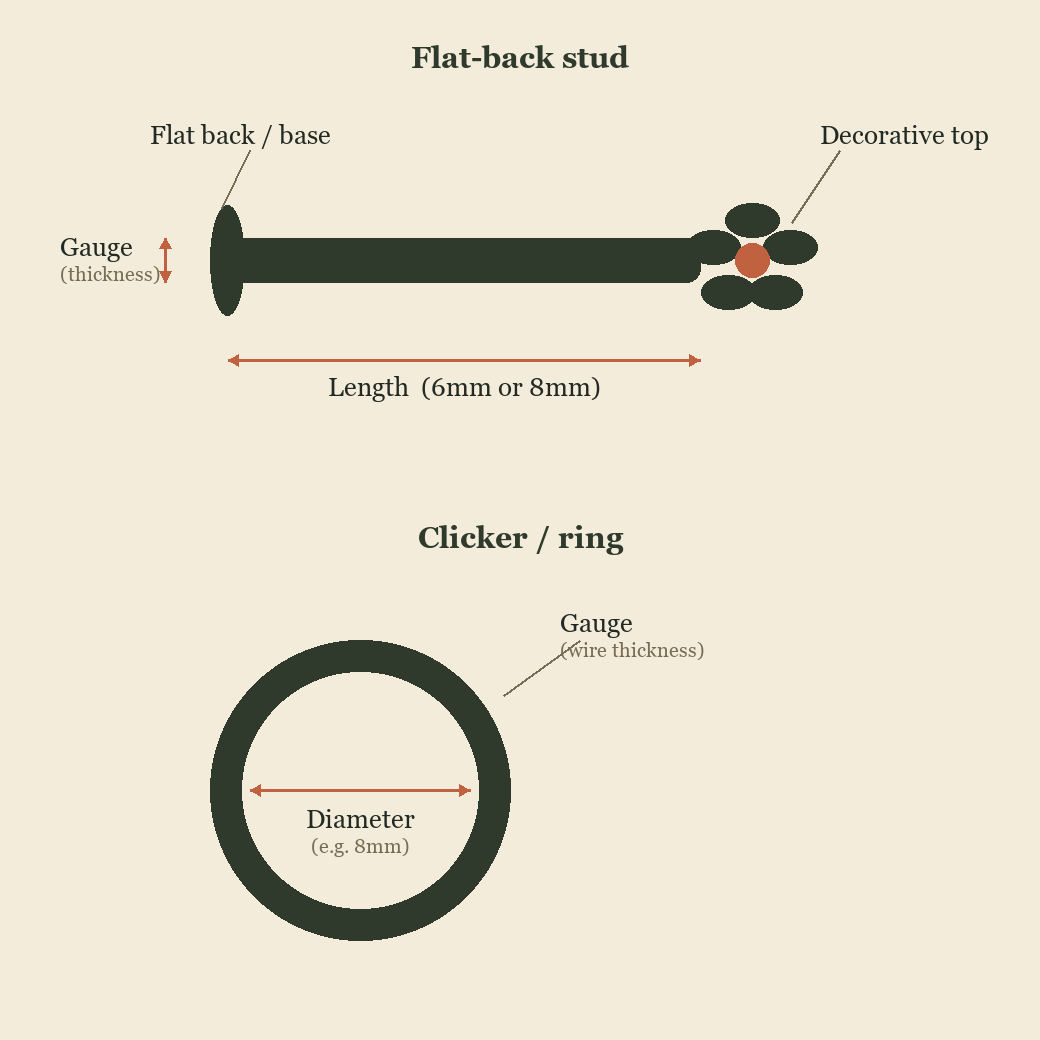
Gauge is simply the thickness of the bar or wire that goes through your piercing. It is not the length, and it is not the size of the decorative top. It is how thick the post is. Gauge is written with a number followed by the letter g, for example 18g or 16g.
Here is the part that trips everyone up. The higher the number, the thinner the bar. So 20g is thinner than 18g, and 18g is thinner than 16g. The scale runs backwards because it comes from an old wire manufacturing system where the number counted how many times the wire had been drawn through a machine to make it thinner. You do not need to remember the history, only the rule: bigger number means thinner bar.
The gauges you will actually meet
20g is very thin and is most often seen in some nostril piercings and in delicate fashion earrings. It is on the fine end for body jewellery.
18g is a common thickness for healed lobe piercings and many nostril piercings. It is dainty without being fragile.
16g is the workhorse of the piercing world. A large share of cartilage piercings such as helix, conch, tragus, rook and daith are done at 16g, and many people wear 16g in their lobes too. If you are unsure, 16g is the most likely answer for a cartilage piece.
14g is thicker again and is common for navel piercings, some conch and industrial piercings, and anywhere a slightly sturdier bar is wanted.
Why matching your gauge matters so much
Your piercing was made at a specific gauge, and the hole heals to that thickness. When your jewellery matches, the bar fills the channel neatly and sits secure. When it does not match, things go wrong in two different directions.
If the bar is too thin for the hole, the jewellery can move around, sink, migrate or snag, and a healing piercing may be irritated by the constant wobble. If the bar is too thick, you cannot comfortably fit it through the piercing at all, and forcing a thicker bar into a smaller hole is a fast route to trauma and swelling. Neither is worth risking for the sake of a piece you liked the look of.
Gauge, length and diameter are three different things
People often mix these up, so it helps to separate them. Gauge is the thickness of the bar. Length is how long a straight post is, which decides how snug a labret stud sits against your skin. Diameter is the width across a ring or hoop. You need all three to be right for a piece to sit well, and the size guide walks through each one with a diagram so you can measure and order correctly.
A quick example. Two labret studs can both be 16g, but if one is 6mm long and the other is 8mm long they will sit very differently, one flush to the skin and one with a little more room. Gauge gets you the right thickness, length and diameter get you the right fit.
Cartilage and lobe are not always the same
It is common to have lobes pierced at 18g or 16g and cartilage at 16g, but there is no single universal answer, because it depends on how you were originally pierced. This is exactly why guessing is risky. The safest move is to check rather than assume, especially if different piercings on the same ear were done at different studios over the years.
How to find your gauge
The most reliable way is to ask the piercer who did the piercing, as they will know the gauge they used. If that is not an option, a reputable piercer can measure your existing jewellery or your piercing for you, usually in a couple of minutes. Some people measure a current piece of jewellery at home with a gauge wheel, but if you are new to this, a quick visit to a studio removes all doubt.
Please do not try to judge gauge by eye from a photo on the internet. The difference between 18g and 16g is small to look at but very real in your piercing.
A note on downsizing
When you are first pierced, your piercer usually fits a slightly longer bar to leave room for swelling. Once the initial swelling settles, often after a few weeks to a couple of months, it is worth going back to have that bar downsized to a shorter length. This is about length rather than gauge, but it matters for the same reason: jewellery that fits the piercing as it actually is will always be more comfortable and heal more happily than jewellery that is the wrong size.
Before you buy
Whoever you buy from, look for a listing that names the metal standard (ASTM F-136 or ASTM F-67 titanium), states the gauge and length or diameter, and says plainly whether any gold colour is PVD or plating. If a seller cannot tell you, buy somewhere else. My guide to checking jewellery is genuinely nickel-free walks through what to look for, and the size guide covers the measurements.
What happens when the gauge is wrong
It helps to picture the two failure modes. If the bar is too thin for the hole, the jewellery has room to move, and in a healing cartilage piercing that constant movement can encourage the piercing to migrate, meaning it slowly shifts position, or in a worse case to reject and grow out altogether. Too thin can also let a heavy top hang and drag. If the bar is too thick, you simply cannot pass it through the piercing without forcing it, and forcing is how you get swelling, bleeding and a very unhappy piercing. Neither is a small cosmetic issue, which is why matching the gauge is worth the small effort of checking.
Gauge is not the same as stretching
There is a separate world of deliberately stretched piercings, where a lobe is gradually taken up through the gauges over months to hold larger jewellery. That is a slow, intentional process done in small steps with proper care. It is completely different from choosing the right gauge for a standard piercing, and the two should not be confused. If you simply want jewellery that fits the piercing you already have, you are matching your existing gauge, not stretching it. Never try to force a larger gauge into a standard piercing to get there faster, as that is exactly how tissue gets damaged.
A quick starting reference
As a rough guide to orient yourself, healed lobes are commonly 18g or 16g, the majority of cartilage piercings such as helix, tragus, conch and rook are 16g, and navel piercings are often 14g. Please treat this as a starting point for conversation rather than a rule, because the only number that matters is the one your piercing was actually made at. When a listing shows a gauge, that is the thickness of that exact piece, so you can match it to what you know you wear.
A few common questions
Can I put a slightly thinner bar in to make it fit more easily? Better not, because the looseness that makes it easy to insert is the same looseness that causes movement and irritation. Can I file or force a thicker bar through? No, and it is not worth the damage. Does gauge really affect healing, or just fit? It affects both, because a secure, correctly sized bar sits calmly in the piercing and lets it settle, while the wrong gauge keeps disturbing it. When in doubt, the answer is always to check with your piercer rather than to guess and hope.
Measuring at home, if you want to
If visiting a studio is not practical, you can get a reasonable idea at home. A gauge wheel is an inexpensive tool with slots cut to standard gauges, and you slide a piece of jewellery into the slot it fits to read off the number. A digital calliper works too, measuring the bar thickness in millimetres, which you then match to a gauge, for example 1.2mm is 16g and 1.0mm is 18g. These are useful for identifying jewellery you already own. For a piercing itself, though, a piercer remains the most reliable source, because they can see how the piece sits in the channel rather than just its dimensions.
Whichever way you arrive at your number, once you know it, buying gets much easier: check the gauge is stated on the listing, and the size guide explains how gauge, length and diameter work together. Get those three right and your jewellery will feel like it was made for you, because in a sense it was.
Trusted sources
For more on choosing safe, correctly sized pieces, the Association of Professional Piercers has a useful guide to jewellery for initial piercings, and their aftercare advice covers downsizing as a piercing heals.
Gemma
Leave a Reply