

If your ears go red, itchy or sore every time you wear earrings, you are not unlucky and you are not doing anything wrong. You almost certainly have a nickel sensitivity, and you share it with a very large number of Australians. The good news is that it is completely solvable. The bad news is that the word hypoallergenic, which is plastered across half the earrings sold in this country, means almost nothing.
This guide explains what actually causes the reaction, what to look for when you buy, and which pieces are genuinely safe for sensitive ears. It is written for Australian shoppers, in Australian dollars, by someone who has spent a lot of money learning this the expensive way.
The short answer
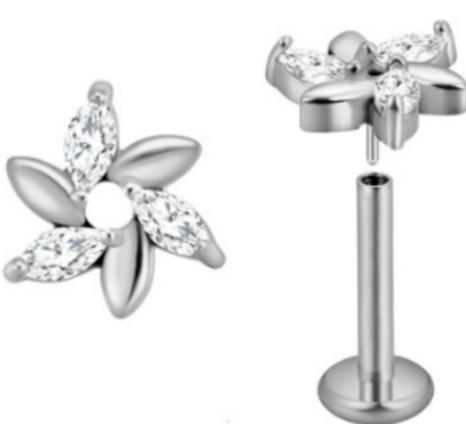
Buy implant grade titanium, specified as ASTM F-136. That is the whole answer. It contains no nickel at all, which means there is nothing there to react to. Not surgical steel, not sterling silver, not gold plated brass, not anything described only as hypoallergenic or nickel safe. If a seller cannot name the standard their metal meets, assume it does not meet one.
If you want to understand why, and how to spot the marketing language that gets used instead of facts, keep reading.
What is actually happening to your ears
Nickel allergy is a delayed contact allergy. Your immune system has decided that nickel is a threat, and every time nickel touches your skin for long enough, it mounts a response. That response is the redness, the itch, the weeping and sometimes the little crusted patch behind the earring. It usually shows up hours after you put the earrings in rather than immediately, which is why so many people never connect the two.
It is one of the most common contact allergies in the world, and it affects women considerably more often than men, largely because of earrings. It is also something you develop rather than something you are born with. Repeated exposure is what sensitises you, and once you are sensitised, you stay that way for life. That is worth sitting with for a moment, because it changes how you think about cheap earrings: they are not just uncomfortable, they are how the problem gets created.
Piercings make all of this worse. Ordinary skin has a barrier. A piercing channel does not, or at least not a fully formed one, so the metal is in direct contact with living tissue for twenty four hours a day. That is the ideal set of conditions for both provoking a reaction and creating a new sensitivity.
The words that mean nothing
Australian jewellery listings are full of reassuring language that carries no legal weight whatsoever. It is worth learning to read past it.
- Hypoallergenic. Not a regulated term. Anyone can print it on anything. It expresses a hope, not a specification.
- Surgical steel. Sounds medical, is not a single defined thing, and every variety of it contains nickel.
- Surgical grade. A step vaguer again. There is no such grade.
- Nickel free. Sometimes true and sometimes means the nickel is below a release threshold rather than actually absent.
- Titanium plated or titanium coated. A thin surface layer over something else entirely. When it wears, you meet whatever is underneath.
- Sterling silver. Nickel free in principle, but tarnishes, and the alloy varies by maker.
The phrase that does mean something is ASTM F-136. That is a real, published, testable standard for implant grade titanium alloy, and it specifies exactly what the metal is made of. If a seller names it, you can ask for the test report. If they cannot produce one, you have learned something useful.
Why implant grade titanium is different
Implant grade titanium is the alloy used to make surgical implants that live inside the human body for decades. It is titanium with roughly six percent aluminium and four percent vanadium, refined to remove impurities, and there is no nickel in the recipe at all. Not a small amount, not a locked in amount. None.
That is what makes it the right answer for sensitive ears. Every other approach is about keeping the nickel from getting out. Titanium removes the nickel from the equation entirely, so there is no threshold to worry about, nothing to leach as the piece ages, and nothing that becomes a problem if the plating wears through. It is also light, which people notice immediately, and it does not tarnish.
I have written a longer piece comparing titanium, surgical steel and sterling silver if you want the full breakdown of each.
What about gold?
Gold is where most people get caught out, because gold itself is not the problem. Pure gold is inert and perfectly safe. The problem is that pure gold is far too soft for jewellery, so it is always alloyed with something, and in cheaper gold jewellery that something very often includes nickel. Gold plated pieces are worse again, because the plating is a thin skin over a base metal, and that base metal is usually brass or nickel alloy. When the plating wears, which it always does eventually, you are wearing the base metal directly.
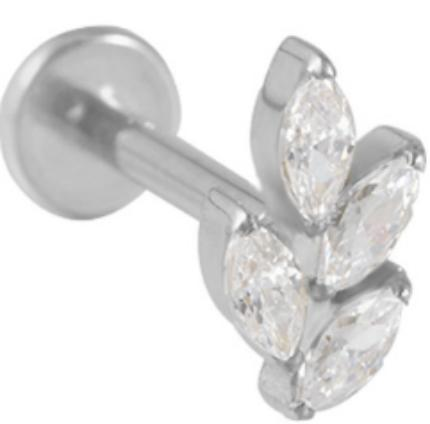
There are two safe ways to wear gold with sensitive ears. Solid gold, at 14K or 18K, from a maker who will tell you what the alloy contains. Or gold PVD over implant grade titanium. PVD is a vacuum process that bonds a hard, thin layer of gold coloured material to the surface, and because the piece underneath is nickel free titanium, even a worn spot exposes nothing but more titanium.
An honest seller describes it as 18K gold PVD on titanium and tells you it stays colourfast for a few years of normal wear, rather than claiming it lasts forever. If a listing promises forever, be wary.
What to buy for sensitive ears
For everyday lobes
A flat back titanium labret stud is the most comfortable thing you can put in a lobe, and it is a revelation if you have spent years with butterfly backs. There is no clasp to press into the back of your ear, nothing to fall off in bed, and nothing to lose down the drain. Choose 18 gauge for most lobes, 16 gauge if you were pierced thicker, and a length of 6mm to 8mm depending on your ear.
For cartilage
The same flat back labret in 16 gauge is the standard, and it is what piercers use. Cartilage is fussier and slower to heal than a lobe, so the nickel question matters even more here. If you are shopping for a healing helix specifically, I have a dedicated guide to that.
For hoops
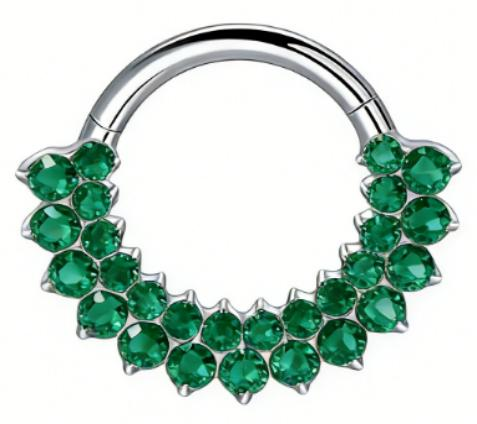
Segment clickers are the nicest option, because they are a single piece of titanium that hinges open and clicks shut, with no join to catch and no separate ball to lose. An 8mm or 10mm ring suits most lobe and healed helix placements.
How to know a seller is telling the truth
Four questions will separate a serious seller from a reseller who has copied a listing. Ask them by email and see what comes back.
- Which standard does your titanium meet? The answer you want is ASTM F-136, sometimes also written as Grade 23 or Ti-6Al-4V ELI.
- Do you hold a composition test report on the metal itself? This is different to a nickel release test. Composition tells you what the alloy is made of. Release testing only measures what escapes the surface.
- Is the gold plated or solid, and what is underneath it? A straight answer here tells you a lot.
- Are the posts and the tops the same material? Some sellers use good metal for the visible part and something cheaper for the post that actually sits in your piercing.
A good seller will answer all four without hesitation. If they dodge any of them, take that as your answer.
If you are already reacting
Take the offending earrings out. Do not push through it, because every additional exposure deepens the sensitisation. Clean the area gently with sterile saline and let it settle. If the skin is broken, weeping or spreading, see a GP or a pharmacist, as a genuinely infected piercing is a different problem to an allergic one and needs different treatment.
Once things have calmed down, switch to implant grade titanium and give it a few weeks. Most people find the difference is immediate and slightly annoying, in the sense that they realise they could have solved this years ago. If reactions continue even in titanium, it is worth asking your GP about patch testing, because there are other contact allergies and it is useful to know which one you have.
Sensitive ears are not a personality trait. They are usually just a nickel problem wearing a disguise.
Frequently asked questions
Is titanium really nickel free, or just low nickel?
Genuinely nickel free. ASTM F-136 titanium is an alloy of titanium, aluminium and vanadium, with strict limits on iron, oxygen, nitrogen, carbon and hydrogen. Nickel is not an ingredient. This is why it is used for implants that stay in the body permanently.
Can I wear titanium if I react to everything?
Almost certainly, yes. Titanium is one of the least reactive metals there is, which is exactly why it is used surgically. True titanium allergy exists but it is genuinely rare.
Is sterling silver safe for sensitive ears?
Usually, but not always, and it is a poor choice for anything healing. Sterling is 92.5 percent silver and 7.5 percent something else, most often copper, but the alloy is not standardised the way implant titanium is. It also tarnishes, and tarnish sitting in a piercing is not something you want.
Why is titanium jewellery more expensive?
Because the metal costs more and it is harder to machine. In practice the difference on a single stud is a few dollars. Set against years of sore ears, it is not really a cost.
Before you buy
Whoever you buy from, look for a listing that names the metal standard (ASTM F-136 or ASTM F-67 titanium), states the gauge and length or diameter, and says plainly whether any gold colour is PVD or plating. If a seller cannot tell you, buy somewhere else. My guide to checking jewellery is genuinely nickel-free walks through what to look for, and the size guide covers the measurements.
Trusted sources
I only cite organisations that publish their own standards and research, so you can check anything here for yourself.
- DermNet: nickel allergy
- Association of Professional Piercers: jewellery for initial piercings
- Association of Professional Piercers: aftercare guidelines
Gemma
Leave a Reply